Home Maintenance Resolutions for 2020

Homes need continuous maintenance to keep them in good condition. Plan to invest one to four percent of your home’s value in maintenance costs each year to avoid losing home value!

1. Interior
If you invest time in some simple maintenance, you can keep the inside of your home looking like new. Some tasks your home may need include repainting the walls, restripping and resealing wood, or restaining trim and built-ins. Some more complicated repairs may involve replacing worn or outdated floors or rebuilding fixtures.

2. Exterior
Taking time each year to maintain the exterior of your home will help ensure your home doesn’t take in excessive damage-causing moisture. Some tasks you should complete each year include cleaning and repairing your gutters/downspouts, inspecting and repairing your roof, and repainting, cleaning, and repairing your home’s siding.

3. Systems
Part of keeping your home in good condition is ensuring your systems are running safely. Cleaning your chimney flue, replacing air filters, and other inspection and cleaning projects can keep your home and family safe by helping to prevent floods and fires caused by poorly maintained systems.

4. Landscaping
Keeping your outdoor structures and landscaping in good condition is also important. Keep an eye out for erosion issues, rodent infestations, and dangerous trees. You should also refinish your deck, fence, and other wood structures semi-annually.

RE/MAX National Housing Report for December 2019

December posted a record finish to a year and a decade, with a year-over-year increase in home sales of 13.5% in the 54 metro areas covered by the report. That was the highest increase of any month in 2019, and the highest for the month of December since 2009.

Also posting a record for 2019 was the inventory decline of 14.5% year-over-year, accompanied by corresponding drops in Months Supply of Inventory – 3.3 vs. 4.8 a year earlier – and Days on Market – 54 compared to 55 a year ago.

Year-over-year, sales were up five months in 2019, with the majority occurring in the back half of the year. Inventory, meanwhile, grew year-over-year in each of the first six months, then shrunk in each of the last six months.

The Median Sales Price of $266,000 was 11.1% higher than December 2018 and the highest year-over-year increase for any month of 2019.

Read the full article

Watch the 40 second summary video

Washington State NWMLS Market Snapshot for December 2019

Newly-released figures from Northwest MLS show inventory at the end of December was down 31% from the same month a year ago, with only 8,469 active listings compared to the year-ago total of 12,275. The figures include single family homes and condominiums across the 23 counties in the MLS service area.

Inventory for single family homes and condos (combined) was down by more than 30% in seven counties: Thurston (-54%), Pierce (-38.9%), King (-38.8%), Snohomish (-35.6%), Mason (-32%), Kitsap (-30.6%), and Skagit (-30.5%).  System-wide there is only about 1.2 months of supply.

December’s volume of active listings included 3,777 new listings added during the month, but during the same time frame, 5,943 sellers accepted offers on their properties. That number of pending sales was up about 4.7% from twelve months ago.

Northwest MLS member-brokers recorded 7,093 completed transactions during December, a gain of more than 11% from the 6,374 closed sales of the same month a year ago. Prices on last month’s closed sales of single family homes and condos rose 8.75% from a year ago. For the MLS market overall the price was $435,000 versus the year-ago figure of $400,000.

For the four-county Puget Sound region (encompassing King, Kitsap, Pierce and Snohomish counties), the median sales price for December’s closed sales was $495,000, up 10% from the year-ago figure of $449,950.

Source: NWMLS 1/6/20

The Global Demand for Affordable Housing

The subject of affordable housing in cities around the world is becoming a focus of discussion as we move into the next decade. Whether it be in Los Angeles, San Francisco, London, Sydney, or Cape Town, academics, politicians, and developers are trying to solve the growing problem.

It cannot be a solution to the demand for housing in thriving cities, to move people further away from the city in search of cheaper places to live. The cultural issue is how to bring about significant increases in supply to city precincts without resorting to building on green belts and other open areas. Various cities will require the incumbent powers and political leaders to align with housing providers, new financial models, and the market to support low-cost housing essential to creating economically successful and enduring living places.

LA’S CRISIS

Los Angeles’ affordable housing crisis is well documented. According to the annual report from the California Housing Partnership, LA county would need over half a million units of affordable housing to meet the demand from low-income renters. In most major cities around the world, the price of most market-rate units is out of reach for low-income earners.

Most definitions of affordable housing are homes affordable to those entering or in the housing market but unable to access current planned or available supply either because of income circumstances or the stage of their lives.

According to the California Housing Partnership, the crisis is more significant than single communities. No matter how hard local governments and citizens work, help is needed from state, provincial, and federal authorities. A report by Savills in Britain estimated that as many as 500,000 families a year are unable to access available housing supply.

In Sydney and Cape Town, demand for affordable housing far exceeds supply. A comparison between the 20 most affordable Sydney suburbs for low-income earners in 2006, and again in 2010, found dramatic reductions in the number of affordable properties. The suburb of Westmead, for instance, recorded a 90 percent reduction in affordable properties over the period. A study done in Cape Town by a prominent architect suggests that mixed-income high-rise residential developments have the potential to break the mold. Integrating private sector investment and provision of tax breaks to developers would allow a larger budget for better aesthetics in design, giving people from a spectrum of income groups the ability to be accommodated in previously exclusive city areas. Blended buildings would provide people with inhabiting social housing units more integrity and all the inhabitants a sense of value and strong dignity.

We have a way to go before viable solutions are found to this problem, but comfort can be found in the fact that some of the most qualified people are applying their minds to solving the global affordable housing crisis.

Source: Washington REALTORS®

Top 10 Outperforming Markets

Metro Areas NAR Expects Home Price Appreciation to Outpace in the Next 3 to 5 Years

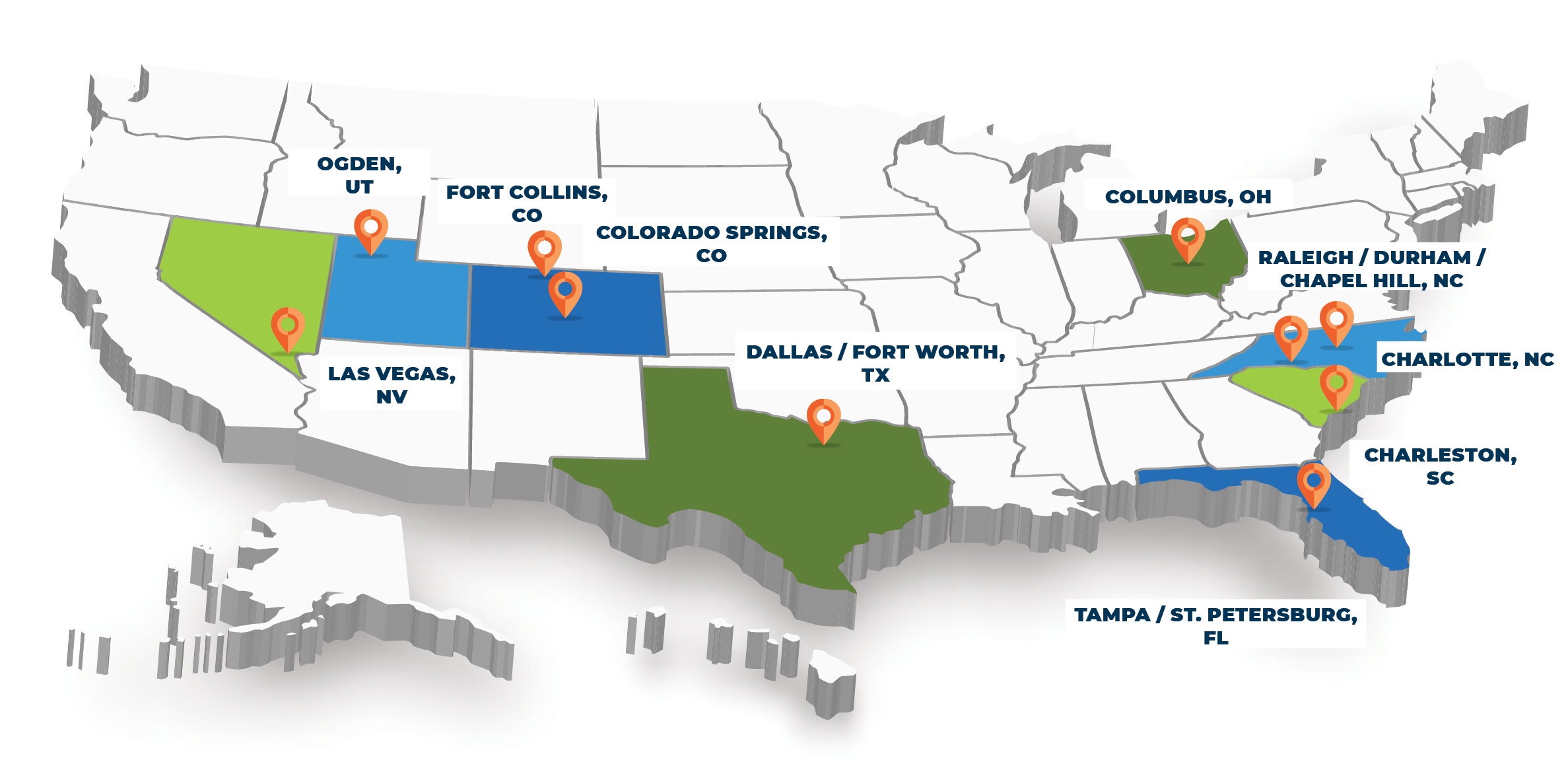
The National Association of REALTORS® identified the top metro areas taking into account a myriad of variables, including domestic migration into the area, housing affordability for new residents, consistent job growth outperforming the national average, age structure of the population, attractiveness for retirees, and the area’s home price appreciation.

In alphabetical order, the markets are:

  • Charleston, South Carolina
  • Charlotte, North Carolina
  • Colorado Springs, Colorado
  • Columbus, Ohio
  • Dallas-Fort Worth, Texas
  • Fort Collins, Colorado
  • Las Vegas, Nevada
  • Ogden, Utah
  • Raleigh-Durham-Chapel Hill, North Carolina
  • Tampa-St. Petersburg, Florida

Read more on the National Association of REALTORS® website…

5 De-cluttering Tips for Your Kitchen

Is the chaos on your countertop out of control? Here are a few tips to conquer the clutter.

  1. Use it or move it
    If you don’t use a mixer, food processor, or other tool more than once a week, stash it in a cupboard. Counter space is precious real estate.
  2. Wall-to-wall organization
    Mount a rack on your wall for storing all those things that tend to pile up on your kitchen table and counters – like mail, to-do lists and receipts.
  3. Look up
    The space on top of your wall cabinets and fridge are great places for wire baskets that let you see the contents, or fabric bins that hide things from view.
  4. What’s behind Door #1?
    Place over-the-door storage racks inside pantry doors to free up counter space.
  5. Hang ten
    Or even a dozen. Keep lightweight items such as aprons, oven mitts, large utensils and towels off counters by mounting wall hooks.

RE/MAX National Housing Report for November 2019

Tight Inventory Accelerates Sales,
Pushes Up Median Sales Price

A fifth straight month of shrinking inventory year-over-year triggered several November records in the 11-year history of the RE/MAX National Housing Report: fewest Days on Market at 49, fewest Months Supply of Inventory at 3.3, and the highest Median Sales Price at $257,000.

In the 54 metro areas covered by the report, November home sales overall averaged 1.0% below November 2018 following significant year-over-year increases in September and October. Thus far, four months of 2019 posted year-over-year sales increases and seven, including November, have seen declines. Three of the monthly declines, however, were less than 2% below 2018 sales levels.

The November Median Sales Price of $257,000 marked a 7.9% year-over-year increase. It was the third-highest year-over-year increase thus far in 2019.  While prices declined month-to-month from June through September, price appreciation began to accelerate in October and the November Median Sales Price topped October by 0.7%. November prices have topped October’s for nine consecutive years, dating back to 2011.

Read the full article

Watch the 40 second summary video

Beware of the Flip

Before the Great Recession of 2008, housing prices climbed dramatically, and homes sold faster than buyers could gush, “I love that spa bathroom.” Contractors and even handy DIYers got in on the uptick by buying fixer-uppers and improving them in the quickest ways possible, selling them, and reaping the profits. Enter the real estate phenomenon of flipping.

The trend waned a bit as the housing market hit the skids, but then returned with some significant differences. Today’s flippers are more often professional investors with access to cash as banks tightened mortgage loan guidelines and available work crews, says Seth Captain, managing broker of Captain Realty in Chicago.

Read the article in REALTOR® Magazine

Real Estate Forecast: Recession Unlikely in 2020

Expect Continued Economic Growth, Slower Real Estate Price Gains and Small Chance for Recession in 2020, According to Group of Top Economists


A group of top economists recently arrived at a consensus at the 2020 economic and real estate forecast at the National Association of Realtors®’ first-ever Real Estate Forecast Summit. The economists who gathered at NAR’s Washington, D.C. headquarters expect the U.S. economy to continue expanding next year while projecting real estate prices will rise and reiterating that a recession remains unlikely.

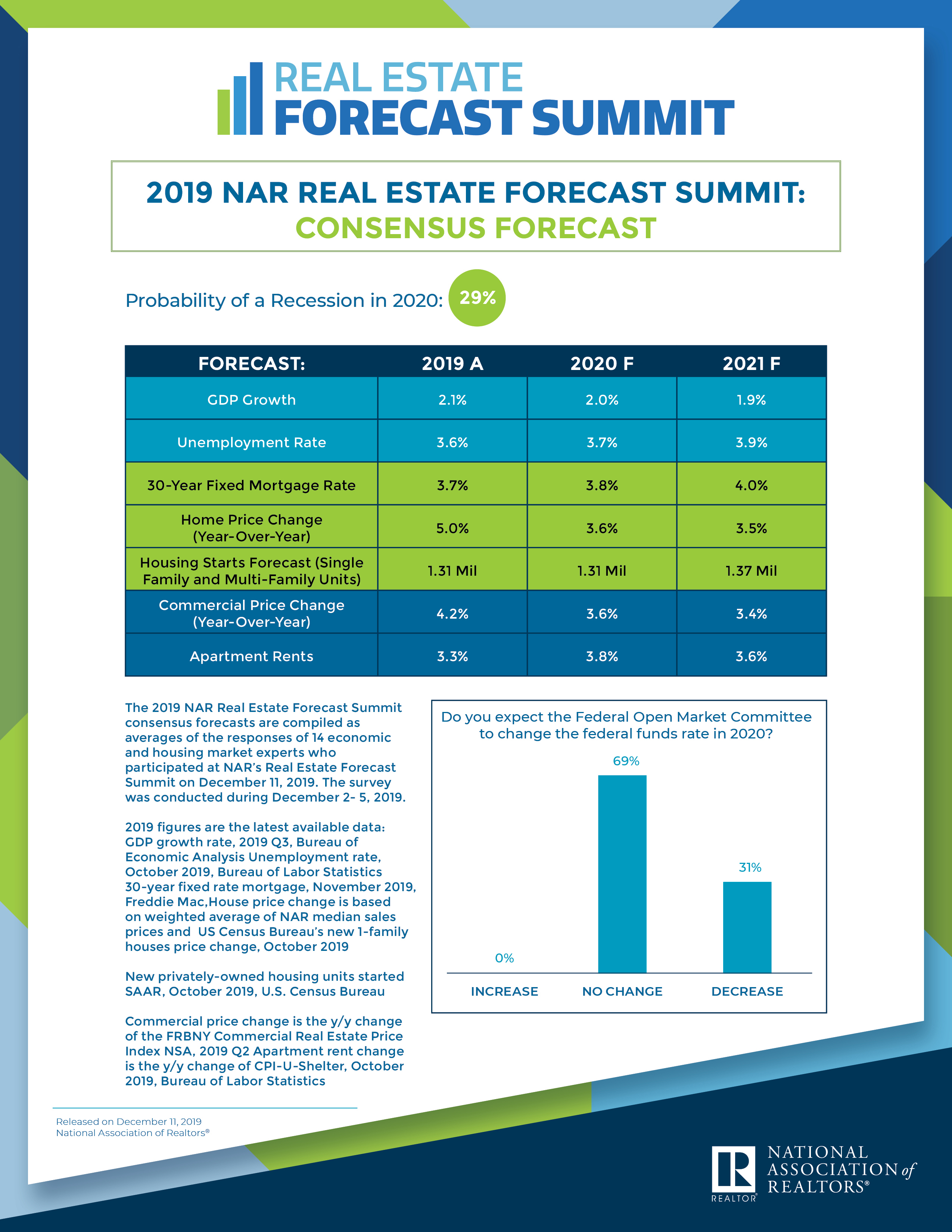
These economists predicted a 29% probability of a recession in 2020 with forecasted Gross Domestic Product growth of 2.0% in 2020 and 1.9% in 2021. The group expects an annual unemployment rate of 3.7% next year with a small rise to 3.9% in 2021.

When asked if the Federal Open Market Committee will change the federal funds rate in 2020, 69% of the economists said they expect no change, while 31% expect the committee will lower the rate next year.

The average annual 30-year fixed mortgage rates of 3.8% and 4.0% are expected for 2020 and 2021, respectively. Annual median home prices are forecasted to increase by 3.6% in 2020 and by 3.5% in 2021.

“Real estate is on firm ground with little chance of price declines,” said NAR’s Chief Economist Lawrence Yun. “However, in order for the market to be healthier, more supply is needed to assure home prices as well as rents do not consistently outgrow income gains.”

Apartment rents are expected to rise 3.8% and 3.6%, respectively, in 2020 and 2021. According to the group of economists, annual commercial real estate prices will climb 3.6% in 2020 and 3.4% in 2021.

“Residential and commercial real estate investment remains attractive as we approach the start of a new decade,” said NAR President Vince Malta, broker at Malta & Co., Inc., in San Francisco, CA. “Increased home building can serve as a stimulator for the overall economy, and we strongly encourage more homes to be built as buyer demand remains strong.”

The 2019 NAR Real Estate Forecast Summit consensus forecasts are compiled as averages of the responses of 14 leading economists who participated during the summit. The survey was conducted from December 2-5, 2019.

The National Association of Realtors® is America’s largest trade association, representing more than 1.4 million members involved in all aspects of the residential and commercial real estate industries.

Source: National Association of Realtors 12/11/19

The Best Paint Colors for 2020, According to Interior Designers

One of the easiest ways to update your home is by swiping on a fresh coat of paint. No matter which room you’re in — the bedroom, kitchen, or bath — adding a new color to your walls or furniture is a cheap and commitment-free way to make an eye-catching change. And because paint is totally reversible, it’s also one of the best ways to incorporate some of the latest interior design trends into your home every few years.

If you’re ready to make a major change this year, look no further than the top paint colors of 2020, which run the gamut from bubbly blush to earthy clay. To find these paint ideas, we asked interior designers which colors they expected to see in abundance in the new year. Whether your style is modern or traditional, minimalist or extravagant, there’s a 2020 paint color for you. And if you need even more low-cost ways to revamp your space, try one of these DIY home decor projects.

Read Good Housekeeping’s article