A Successful Move Is All in the Details

Nearly 35.5 million Americans move each year, according to data from Move.org. With so much to think about, from organizing and packing to lifting and moving heavy boxes, it’s easy to forget the little things that can make life a little easier during a move. Here are some small details that may get overlooked – tips to make any move smoother and stress free.

Unplug Carefully
Don’t just pull the plug on expensive electronics and toss them in a box – a little planning will help you protect expensive gadgets, like TVs, laptops and stereo systems. Think before dismounting that big, flat-screen TV by yourself. Follow this guide to make sure nothing is damaged. Place all user manuals in a folder so they don’t get lost in the shuffle, but don’t panic if you’ve misplaced them because you can usually find manuals on manufacturers’ websites. Consider a professional mover for your more delicate electronics. Atlas Van Lines suggests using a qualified professional to uninstall any wall-mounted AV equipment and to call in advance to schedule an appointment so you’re not scrambling at the last minute.

Food for Thought
Don’t forget about dinner – you still need to eat during a move. Packing up the kitchen is usually the last, most challenging part of the moving process, but if you make plans you won’t go hungry.

  • Donate: Think about donating canned or unopened food to your local food bank. This leaves one less thing to pack and supports your community.
  • Meal Plan: Use the foods still left in your fridge and freezer for meal planning. Take inventory of the foods you have available leading up to the big day. Home Cooking Memories has some tasty ideas.
  • Label and Organize: Don’t pack up those cooking utensils just yet. Label your moving boxes to easily access the kitchen gadgets you still need to whip up a quick dinner. Consider the packing order of appliances you won’t need, like the blender, and place everyday items, like spatulas, on top for easy access.

The Essentials
You’ve unloaded the last box and you’re ready to shower, eat and relax – only to remember that your toiletries are buried in a dozen boxes, spread across the house. Avoid this all-too-common mistake by packing one or two “essentials boxes” that contain extra clothing, towels, toiletries, medications, bedding and phone chargers that will last up to three or four days.

Know Your Limits
It may be tempting to save money by doing the moving yourself, but don’t get in over your head. Know your limits, suggests OZ Moving and Storage, “If you’re not sure if you can accomplish some part of your move without professional help, don’t try. We were called up once by a trio of college students who had gotten their couch stuck in a staircase. Getting in over your head and having to call emergency help is not ideal.” Get quotes from a few moving companies to determine what needs to be moved or packed by a professional.

A successful move is all in the details – but, with a plan in place you won’t forget the small stuff!


Be Cautious About Renovations Without Permits

Some homeowners bypass the permit process when they remodel their home. They may find the process too expensive or cumbersome. Permitting fees can sometimes cost hundreds of dollars or more. Some homeowners may believe that if they go ahead with a kitchen or bath remodel without a permit, they’ll likely never get caught.

But failing to get a permit could be troublesome when they go to sell the home.

Most states require homeowners to fill out a disclosure statement when they go to sell. In that form, sellers are usually asked if they completed work to the home without a required permit. Lying about it can also backfire—the sellers could be sued later by the new homeowner for making false statements.

“You can personally become liable for work carried out without permits,” writes Bill Gassett, a real estate professional with RE/MAX, REALTORS® in New England, for RISMedia’s Housecall. “Maybe the finished basement built by the previous homeowner with the fancy kitchen that sold the home has to be ripped out, or you’ll have to pay a penalty.”

Also, if there’s any incident that was caused by the lack of permits, the homeowner may face a denial of their insurance claim. If their insurance company finds they didn’t have the required permit, they could deny the claim. Many of these denied insurance claims stem from incidents that involve remodeling projects around electricity, gas, or water that were done without the appropriate permits.

Source: REALTOR® Magazine

Spring Is in the Air: More Homes Going Up for Sale

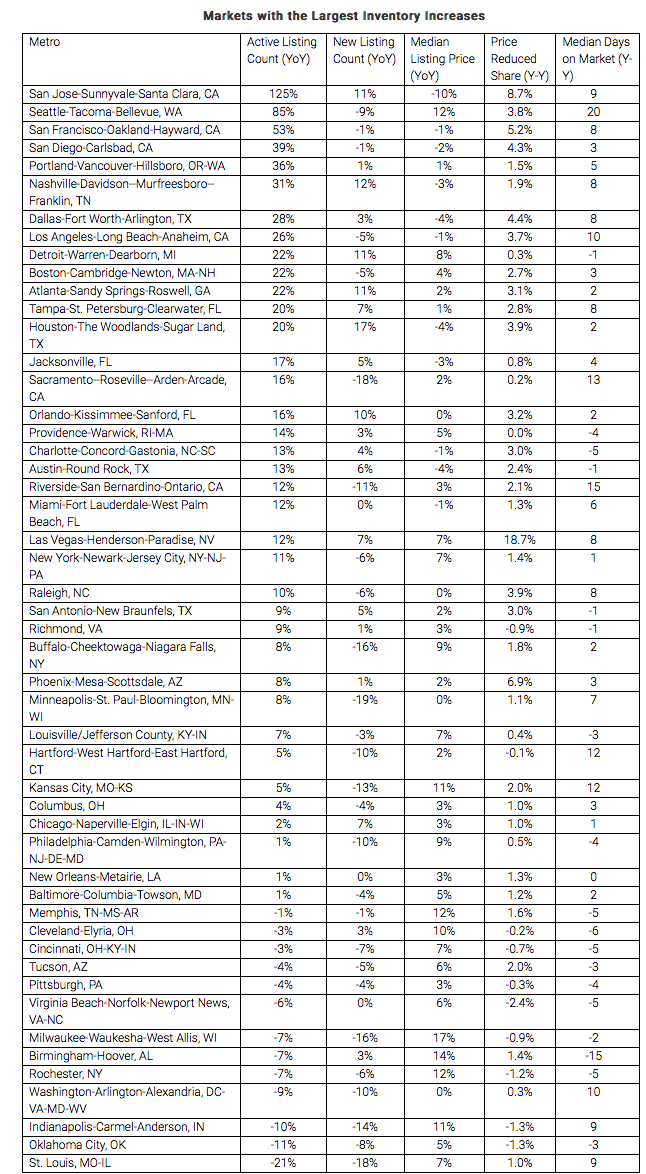
The housing market is changing quite a bit from a year ago. The number of homes up for sale is growing, reversing an inventory shortage trend that has plagued many markets over the last few years. The higher inventories are also driving greater price cuts, according to realtor.com®’s February housing report.

About 73,000 more listings are for sale this year compared to last year. Inventories have increased 6 percent year over year, according to realtor.com®’s analysis. The largest jumps in For Sale signs are out West, led by San Jose, Calif. (up 125 percent year over year); Seattle (up 85 percent); San Francisco (up 53 percent); San Diego (up 39 percent); and Portland, Ore. (up 36 percent).

“This is the fifth consecutive month that we’ve seen housing inventory increase, especially in large markets,” says Danielle Hale, realtor.com®’s chief economist. “As is often the case in real estate, the important trends are going on at the local level. We see large markets continue to cool, but some markets still have some strength. Additionally, we still see fewer homes priced under $200,000 on the market, so entry-level buyers won’t see the same availability of options as high-end buyers.”

The median list price rose 7 percent year over year in February to $294,800. But prices are showing signs of cooling. Thirty-nine of the 50 largest housing markets saw an increase in price cuts in February. The largest percentage of price cuts were in Las Vegas (up 19 percent); San Jose (up 9 percent); Phoenix (up 7 percent); San Francisco (up 5 percent); and Dallas (up 4 percent).


The High-Priority Home Features for Buyers

Laundry rooms and Energy Star–compliant windows topped the list of what buyers considered the most “essential” or “desirable” features in a home, according to the National Association of Home Builders’ 2019 “What Home Buyers Really Want” report, released at the NAHB International Builders’ Show in Las Vegas this week. Most of the features that new homeowners or aspiring buyers ranked highest related to helping them save in utility costs, add extra storage, and spruce up the outside, said Rose Quint, the NAHB’s assistant vice president of survey research.

The NAHB surveyed nearly 4,000 consumers who either purchased a home within the last three years or plan to buy a home in the next three years to identify their top desires in a home. Consumers were asked to rank 175 home features based on how essential they were to their home purchase decisions.

Consumers ranked the following home features highest:

  1. Laundry room: 91%
  2. Energy Star windows: 89%
  3. Patio: 87%
  4. Energy Star appliance: 86%
  5. Ceiling fan: 85%
  6. Garage storage: 85%
  7. Exterior lighting: 85%
  8. Walk-in pantry: 83%
  9. Hardwood flooring: 83%
  10. Double kitchen sink: 81%
  11. Energy Star–whole home: 81%

Read the full article here…

Why 2019 Promises to Be Better for Buyers

After inventory and affordability challenges in 2018, prospective home buyers may have better chances of scoring a property this year. Affordability will remain an issue in some high-priced markets, says realtor.com® Chief Economist Danielle Hale, but overall, the national market is looking brighter for buyers who have stayed on the sidelines. Here’s why.

More homes are for sale. For the last few years, a limited number of listings has given buyers fewer choices. But housing experts predict more robust inventory this year. “For buyers, there is going to be more inventory, so that’s a bright spot,” Hale says. “The downside of that bright spot is it might not be in their price range.” The supply of homes for sale under $300,000 may not grow significantly, but they’re also not decreasing, she adds.

Home price growth is slowing. Home prices will still rise but at a much slower pace than the last few years. Hale predicts a 2.2 percent increase in home prices this year, down from last year’s nearly 5 percent growth. “We do still anticipate rising home prices, particularly for below-median-priced homes, so buyers in that price range may have some incentive to buy sooner rather than later,” Hale says. On the flip side, “as rising costs raise the bar to homeownership, some would-be buyers will be knocked out of the market. [That means] remaining buyers may have less competition to contend with than they saw in 2018.”

Mortgage rates are lower. The 30-year fixed-rate mortgage has backed away from the 5 percent mark, decreasing early this year. That means lower borrowing costs for buyers. The 30-year fixed-rate mortgage averaged 4.41 percent last week. “That’s definitely a huge opportunity for buyers because it drastically improves affordability,” Hale says. “And I think that if these low rates persist for a little while, then we’ll actually see stronger sales than we originally forecast.”

Buyers Far Less Likely to Face Bidding Wars

Home shoppers will likely face less competition in their offers, and that may allow them more time during their house hunt.

A new report from Redfin shows that only 13 percent of offers written by agents on behalf of their customers faced a bidding war last month—down significantly from 53 percent a year ago.

“Buyers have heard the market has slowed, so now they’re trying to get all of their ‘wants,’ not just their ‘needs,’ ” says Kalena Masching, a Redfin real estate pro in Palo Alto, Calif. “They’re waiting until they find a home they can check more boxes—for instance, three bedrooms instead of two or a higher rated school. In general, they are being more judicious as they think through their purchase. Meanwhile, many sellers have not yet recognized that the market has shifted.”

The number of homes for sale has been slightly increasing in several markets, which has left fewer home buyers competing for each home. In December, the number of homes for sale had grown by 5 percent over a year ago.

Several West Coast markets continue to be among the most competitive, but many are seeing fewer bidding wars compared to a year ago. Portland, Ore.; Denver; and San Diego each saw less than one out of five offers face a bidding war, down from more than half of offers a year earlier, Redfin reports. San Francisco, Los Angeles, and Seattle posted the biggest year-over-year percentage drops in bidding wars.

Meanwhile, the least competitive housing markets in January that overall saw the fewest bidding wars were Miami (3 percent), Dallas (6 percent), and Houston (6 percent).

Source: REALTOR Magazine

3 Strategies for the Move-Up Buyer

Moving up to your “forever home” is exciting. When you bought your first place, chances are you were young, strapped for cash and prepared – if not warned – to make some concessions. The move-up buyer typically has some savings and home equity to work with, making this next move feel less like a compromise and more a thoughtful selection.

But move-up buyers face their own set of challenges that call for a carefully considered strategy. Here are three options for the smart move-up buyer with a plan!

The “Sell First” strategy is ideal for the move-up buyer who can’t afford to pay two mortgages simultaneously. Selling your property first eliminates the risk of having to carry two mortgages if you don’t sell your existing home in time. It also reduces the chances of having to reduce your asking price in the interest of speeding up the sale. This is a good option for move-up buyers who are banking on the proceeds of their sale to fund their new (and likely more expensive) property. By selling first, you’ll know exactly how much money you have to purchase your next home.

If homes in your area of choice are selling faster than the ‘For Sale’ signs can hit the front lawn, the “buy first” strategy might be the way to go. By buying your new home before selling your old one, you won’t feel rushed into settling for a sub-par property, or having to seek alternative temporary housing options while you shop the market. This move-up buyer still lives in his or her existing home, allowing them time to shop around, and continue looking until they find that perfect place. This move-up buyer typically requires a bridge mortgage.

When all is said and done, this move-up buyer approach is the most ideal, but getting there is another story. Aligning your purchase and sale closing dates can be tricky. Remember that there are three dancers in this tango – you, the person you’re buying from, and the person you’re selling to. You’ll also have to move out and move in on the same day. In this scenario, time is your best friend and flexibility your savor. This means you’ve planned ahead – you’re researched neighborhoods, gotten pre-approved for a mortgage, and you’ve started the organizing and de-cluttering process before the big move.

The right move-up buyer strategy depends on a number of factors, such as your financial situation, current housing market conditions, your personal comfort level and your personality. Consider all these when making your decision. Plan ahead and work with a pro to ensure a smooth transaction on both sides of the bargaining table.

During my 17 years in the business, I’ve helped many move-up buyers and will be happy to help you and those you know!

Outdated Advice Buyers Should Ignore

People who have gone through the homebuying process are often eager to give advice. But too often, these so-called insider tips may very well be outdated.

Realtor.com® recently highlighted some of the most common advice home buyers may hear from their peers that no longer applies in the current housing market, including:

“Wait for spring.”

Buyers shouldn’t feel like they’ll be at an advantage if they wait for the busiest season in real estate—it may be the opposite, real estate pros say. “Yes, there’s more inventory [in the spring], but there’s more competition for it, and sellers are more optimistic about getting a higher price then and so less willing to negotiate,” Sebastian “Seb” Frey, a real estate broker in the Silicon Valley area, told realtor.com®. “Buy when you find the right property that will meet your needs for today—and the next five to 10 years.”

“Wait for home prices to come down.”

Some aspiring buyers may be told to wait until home prices settle some before they jump in. But they can’t forget that rents are likely also high.

“Paying high rent now and hoping that you’ll find a better deal two or three years down the road [won’t work],” Frey says. “The better advice is to make a smart buy today for a property that will appreciate over the longer term.”

“Make a lower offer so you have room to negotiate.”

Some buyers may be told by their peers to make an offer that’s less than what they’re actually willing to pay for a home. Then they’ll have room to negotiate.

“The housing market in 2019 will be slightly different from what we experienced in 2018 when it comes to pricing and negotiations,” Howard Margolis, an associate real estate broker with Douglas Elliman in New York, told realtor.com®. “In regards to negotiations, what was once the premise of offering 10 percent to 15 percent below asking is not necessarily the case anymore, and it’s a strategy I would not recommend. In today’s market, a truly motivated seller is less inclined to engage in the back-and-forth of a real estate transaction, and listings are priced closer to the final sales price.”

Instead, home buyers are urged to base their offer on sales of similar sales in the area.

November 2018 Housing Affordability Index

At the national level, housing affordability is down from last month and down from a year ago. Mortgage rates rose to 4.99 percent this November, up 19.1 percent compared to 4.19 percent a year ago.

  • Housing affordability declined from a year ago in November moving the index down 10.6 percent from 161.0 to 144.0. The median sales price for a single family home sold in November in the US was $260,500 up 5.0 percent from a year ago.
  • Nationally, mortgage rates were up 80 basis point from one year ago (one percentage point equals 100 basis points).
  • The payment as a percentage of income was up from last month at 17.4 percent this November and up from 15.5 percent from a year ago. Regionally, the West has the highest payment at 23.8 percent of income. The Northeast had the second highest payment at 17.1 percent followed by the South at 16.8 percent. The Midwest had the lowest payment as a percentage of income at 13.7 percent.

Read the full article…

5 Millennial Real Estate Trends in 2019

More millennials are pursuing homeownership now than ever before. The national homeownership rate rose to 64.4 percent in the third quarter this year—an increase of half a percentage point over a year ago, according to the U.S. Census Bureau. That’s largely attributed to the rise in new, first-time home buyers.

As 2018 comes to a close, Dana Bull, an agent with Sagan Harborside Sotheby’s International Realty who has significant experience working with millennial clients, shares five trends to expect from this generation of buyers in the coming year.

1. Rising Interest Rates Will Prompt Buyers to Change Strategy
Just last week, mortgage rates rose to a seven-year high, with 30-year fixed-rate mortgages averaging 4.94 percent. It’s more than likely that rates will climb over 5 percent in the new year. This will cause many buyers to pause and reevaluate their purchasing power and strategy, Bull says. “Even a quarter point has a real impact on housing affordability,” she says. This means you’ll need to take more time to help clients analyze deals and understand what their money can buy in this shifting market.

2. Increased Competition From Baby Boomers for Properties
As millennials age and grow in their careers, they are acquiring more purchase power. According to the 2018 National Association of REALTORS® Home Buyer and Seller Generational Trends Report, 30 percent of millennials purchased homes for $300,000 and higher in the past year, up from 14 percent in 2013. That means millennials and boomers are going head-to-head for the same homes today. That trend is only going to continue to grow in 2019, Bull predicts. Both groups also seek similar amenities, including walkable neighborhoods and smaller home sizes with more upgrades, she points out. “Buyers in different generations—with wildly different points of view—are competing for the same homes,” she says. “For sellers and agents, catering to two different generations in marketing homes will also be a challenge.”

3. Willing to Put In Sweat Equity
Millennials are becoming more savvy to renovations and repairs, and they may have HGTV to thank for that, Bull says. “Millennial buyers are still far more aware of the work, costs, and implications of a renovation than their parents would have been,” she says. “Popular TV shows mean a more educated millennial buyer who knows what to look for in terms of red flags. But also has more confidence around renovating a home to make it their own and the ability to see past outdated wallpaper or a wall that can be easily removed.” Keep this in mind as interest rates continue to rise in 2019 (re: trend number one) and you’re helping clients who want to get creative while staying in their price range.

4. Clients Who are Well-Researched and Prepared 
Millennial buyers are doing their online research and are entering the market well-prepared. Show your value as a REALTOR® in other ways, Bull recommends. “They are relying on real estate professionals not to introduce them to homes, most of which they can find online, but to show them what can’t be researched: neighborhoods that are up and coming, which properties stand to gain value in the coming years, and guidance when it comes to negotiations and inspections.”

5. Social Media’s Continued Impact
Social media will continue to influence millennials’ homebuying habits, Bull says. This generation relies heavily on online reviews and social media presence to make purchasing decisions. A strong online reputation for real estate professionals is a must in catering to this market, she adds. Showcasing homes on social media—particularly Instagram—is essential for appealing to millennial clients.

Source: REALTOR® Magazine