Buyers May Find Relief in Cooling Housing Market

The housing market is showing several signs of slowing, providing a much-needed break for potential buyers who have been waiting to jump into the market. Existing-home sales were 2.4 percent lower in the third quarter than a year ago, and the drop comes at a time when many areas are starting to see an uptick in new listings.

Home prices in many markets are no longer rising by double digits—or even single digits—annually. But with a strong economy and low unemployment, the housing dip is more of a rebalancing of the market than a sign of a downturn, housing analysts say.

Sellers are realizing there is a slowdown and are starting to cut their prices to better compete. Nearly 29 percent of listings in major markets during the month ending Oct. 14 saw price reductions, according to the real estate brokerage Redfin. “The cycle has moved from seller-advantage to at least mildly buyer-advantage in many parts of the United States,” writes Kenneth Harney, a nationally syndicated real estate columnist. “If you’re a buyer, take your time. But keep in mind: If you shop diligently, this fall could be a smart time to catch a deal—a marked-down price on the house you really want.”

Source: REALTOR® Magazine

Americans Shift Their Perceptions of the Housing Market

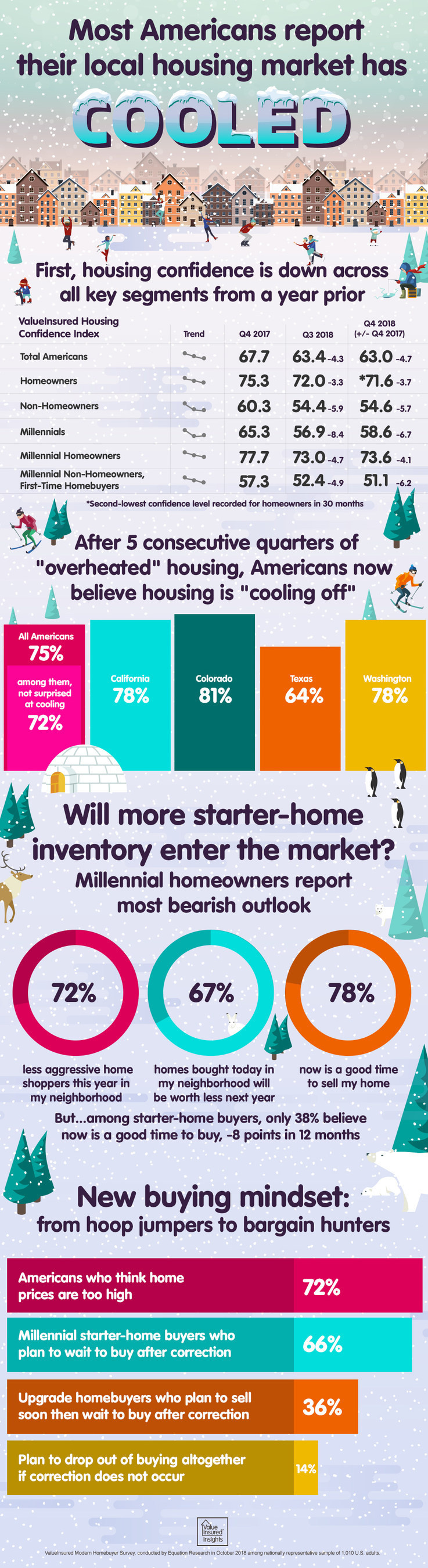
For the past five quarters, the majority of Americans said their housing markets were overheating. Now, in the fourth quarter, 75 percent of Americans say their local housing market is starting to cool, according to ValueInsured’s Q4 2018 Modern Homebuyer Survey. Homeowners in California, Colorado, Texas, and Washington are most likely to say their local market is starting to cool off.

The survey “revealed some concerning evidence about the changing psychology of the housing market,” says Robert Shiller, a housing economist. “We will be watching these numbers as they unfold over the future.”

Seventy-two percent of Americans and 78 percent of “urban residents” say home prices are still too high. Urban homeowners blame “flippers and speculative investors” and “wealthy transplants from more expensive housing markets” for inflating their local home prices to unsustainable levels, according to the report.

Some home buyers may hit the pause button to see what happens in the housing market. Fifty-nine percent of interested home buyers (which includes first-time and move-up buyers) say they plan to wait for a “meaningful correction” before they buy. Fourteen percent say they plan to not buy at all until a correction occurs.

Several markets are seeing home prices slow. ValueInsured’s report notes that the fastest drops in home prices have been happening in Seattle, and North Texas has seen some of its largest sales declines in seven years.

“Buyers have switched from ‘hoop jumpers’ to bargain-hunter mode,” says Joe Melendez, CEO and founder of ValueInsured.

Source: REALTOR® Magazine

Why Home Buyers Need to Hurry

While there have been signs recently that the market may be shifting toward the favor of home buyers, prices are still on the rise in many areas around the country. The median sales price in July was $230,411, up 5.8 percent year over year.

But if buyers are hoping to wait it out, remember that mortgage rates are also increasing. The typical mortgage payment jumped 13.1 percent over that same one-year period, due to a nearly 0.6 percentage point increase in mortgage rates, according to new data from CoreLogic, a real estate research firm.

Mortgage rates are expected to keep rising, too. CoreLogic researchers predict a nearly 10 percent increase in buyers’ mortgage payments by next July, twice the rate expected for home prices. Rates are expected to increase by about 0.43 percentage points between July 2018 and July 2019. Housing forecasters predict median home sale prices to continue to rise by 1.8 percent in real terms over that same period.

Based on these projections, CoreLogic researchers predict the inflation-adjusted typical monthly mortgage payment to rise from $937 in July 2018 to $1,003 by July 2019. Furthermore, real disposable income is expected to increase by only around 2.5 percent over the next year. That means “home buyers would see a larger chunk of their incomes devoted to mortgage payments,” CoreLogic researchers note.

To calculate the typical mortgage payment, CoreLogic researchers use Freddie Mac’s average rate on a 30-year fixed-rate mortgage with a 20 percent down payment (not factoring in taxes or insurance). The typical mortgage payment standard is used to help judge affordability since it shows the monthly amount a borrower would have to qualify for to get a mortgage to purchase a median-priced U.S. home.

Nevertheless, while mortgage payments are on the rise, they’re still low by historical standards, CoreLogic researchers note. In July 2018, the typical inflation-adjusted mortgage payment still remained 26.8 percent below the all-time peak of $1,280 in July 2006. The average mortgage rate in June 2006 was 6.7 percent compared to 4.5 percent in July 2018.

Source: REALTOR® Magazine

The 5 C’s of Credit and What They Mean for a Home Loan

You’ve researched the neighborhood and spent hours scouring listings online. You know the best zip codes and school zones and are ready for the next step in the home buying process – getting pre-approval from your mortgage lender.

There is a lot that goes into determining if you qualify for a loan, but most traditional lenders will consider these five categories:

  1. Character

Your credit score will tell lenders about your character and your credit history. Do you pay your bills on time? Are your accounts in good standing? If your credit score is poor, you should focus on improving it before applying for a home loan.

  1. Capacity

This category measures your ability to pay back your loan. Your income, and your job stability, will come into play here, as well your debt-to-income (DTI) ratio. Your DTI is calculated by dividing total recurring monthly debt by gross monthly income. A ratio over 36 percent could mean you’ll pay more interest or that you will be denied a loan. If your DTI is over 36 percent, you should focus on lowering it by paying down your current debt, not taking on more debt and avoiding big purchases, such as a car, on credit before you buy a home.

  1. Capital

Capital refers to the money you have, or will have, to purchase your new home. Buyers with a down payment will have a better chance of obtaining a loan but a down payment is not a necessity. There are various loan programs that do not require a down payment.

  1. Collateral

In the case of home loans, collateral is the home itself. If you default on the mortgage, the bank will seize the home – this is why a home appraisal is almost always required before obtaining a loan.

  1. Conditions

Is it a buyer’s or seller’s market in your area? What is the current interest rate? These are conditions that can impact home prices in your area as well as your ability to get into a home.

Getting pre-approval for a home loan can be intimidating, but it doesn’t have to be. Contact me, and I’ll be happy to help guide you and those you know through the process!

5 Reasons Buyers Should House Hunt in the Fall

The frenzy of the summer real estate market has cooled by the seemingly very same breeze sweeping leaves off the trees across much of the country. But now may be a better time than ever for buyers to do their house hunting.

According to RealtyTrac and realtor.com®, October is the best time to snag a deal on a house. RealtyTrac analyzed more than 32 million sales of single-family homes and condos between 2000 and 2015, finding that those who purchased in October paid 2.6 percent below the average estimated full market value for their property.

If buyers need more reason to start or continue their home search this fall, here are five additional reasons to shop for a home now from Lindsay Szwed, an agent with RE/MAX Suburban in the Chicago area.

Market Shifting to Buyers’ Favor

A housing market defined by rapidly rising home prices, bidding wars, a lack of inventory, and sellers with the upper hand in negotiations may be changing. “The signs are pointing to a market that’s shifting toward buyers,” says Danielle Hale, realtor.com®’s chief economist. “But in most places, we’re still a long way from a full reversal.”

After all, home sales aren’t exactly tanking. Prices for existing homes were up 4.6 percent from a year ago in the National Association of REALTORS®’ latest housing report. The median home list price in August was up 7 percent from last year.

While these numbers are still higher than last year, economists point to a slowing growth in the percentage jumps. Last year, median home list prices increased by 10 percent from the previous year and by 9 percent the year before that.

A recent report from real estate brokerage Redfin showed that more than one in four home sellers dropped their asking price last month. The areas seeing some of the biggest decreases this year are Las Vegas; San Jose, Calif.; Seattle; and Atlanta.

“We’ve hit that tipping point in a lot of these cities where what sellers think they can get is just not possible for many buyers,” Daren Blomquist, senior vice president at ATTOM Data Solutions, told realtor.com®. “Now the pendulum is swinging away from sellers and back toward buyers.”

Economists point to housing affordability as a culprit for the slowdown. Mortgage rates are up 0.82 percent since a year ago; the 30-year fixed-rate mortgage averaged 4.65 percent as of Sept. 20. Each percentage point increase in rates can translate to about $143 more on a monthly mortgage payment, or nearly $51,500 over the life of a loan on a $300,000 priced home, according to realtor.com®.

“Home prices have just gone up too fast,” Blomquist says. “It doesn’t mean that all of a sudden it’s a market that’s going to crash. But it does mean there are limits to what people can afford.”

Fewer Americans Are Willing to Move for a Job

Fewer Americans are willing to uproot their lives to move for new job opportunities, suggests new census data.

About 3.5 million Americans relocated for a new job last year, a 10 percent drop from 3.8 million in 2015. The number has been trending lower, despite the overall population increasing 20 percent over that time, The Wall Street Journal reports.

Why are more people staying put? Experts told WSJ that some blame may rest on rebounding real estate values. Housing costs have soared higher in some regions where jobs may be more plentiful, like East and West Coast cities, but it may be pricing out some who may have otherwise been willing to relocate.

Read the full article on REALTORmagazine

No Housing Recession Over the Horizon

Media reports are increasingly focused on whether a major home sale slowdown, or maybe even a crash, is in the making, in part because many hot housing markets are seeing slackening buyer demand, and nationally 2018 is expected to end with fewer home sales than 2017. But the possibility of a crash is unlikely, says Lawrence Yun, chief economist for the National Association of REALTORS®.

In a piece he contributed to Forbes, Yun says hot markets are seeing a slowdown not because of weak buyer demand, which could be an indicator of a true slowdown, but insufficient supply. When homes come on the market, especially in areas like Seattle and Denver that have strong job growth and little unemployment, they are typically snapped up.

In other positive signs, home price growth remains strong in markets across the country—about 5 percent on a nationwide basis so far this year—and there are no signs of the credit excesses that characterized the housing crisis 10 years ago. “Lending standards today are still stringent, as evidenced by the higher-than-normal credit scores of those who are able to obtain a mortgage,” Yun says. “That is why mortgage default and foreclosure rates are at historic lows.”

In short, Yun says, today’s housing problem stems from insufficient inventory. The supply problem is driving up home prices and worsening affordability and keeping sales from matching demand. That is a serious problem and the answer is to encourage builders to increase supply, Yun says, but it is not a prelude to a crash.

Source: “No Housing Recession Over Horizon,” Forbes.com

Why Buying a Home Is Becoming More Urgent

If your clients are wavering on whether to buy a home, there are several reasons they may want to get more serious about their real estate search, according to MagnifyMoney, a personal finance website. Most importantly, mortgage rates remain historically low—but that isn’t expected to last. They’ve been rising steadily, but rates for the current 30-year fixed-rate mortgage are still well below 5 percent, compared to nearly 19 percent In 1981. “The housing market has been on pretty solid footing now for a number of years, and a lot of that is due to pretty affordable mortgage rates,” says Stijn Van Nieuwerburgh, a real estate professor at Columbia Business School. In a recent Reuters poll, 45 housing analysts predict that by the end of 2019, the average rate for the 30-year fixed-rate mortgage likely will be above 5 percent. So buyers who lock in a rate this year likely will have lower borrowing costs.

Also, escalating home prices aren’t expected to let up anytime soon. According to the Reuters poll, home values in the 20 largest metro areas are expected to increase by another 5.7 percent before the end of the year. The National Association of REALTORS® predicts growth in home prices to continue in the coming years, but year-over-year growth likely will slow to 3 percent or 5 percent. “Homeownership is long-term prospect,” says Paul Bishop, NAR’s vice president of research. “So as long as prices continue to increase at even a modest pace over the next four, five, eight, 10 years, then that equity does build up, in some cases, to quite a substantial part of someone’s net worth.”

Home shoppers who are holding out for more inventory may need to accept that the waiting game likely won’t be successful. At the end of May, there were 1.85 million existing homes for sale, including single-family homes, condos, townhomes, and co-ops. That is 6.1 percent lower than a year ago, according to NAR. Construction is on the rise but new developments are only accounting for about 2 percent of the market, says Van Nieuwerburgh, adding that “we’re not building enough to alleviate those shortages.”

While there are plenty of reasons why buying makes sense now, housing analysts are quick to point out that consumers shouldn’t take the plunge if they’re not ready financially or personally for the commitment. Prospective buyers need to consider financial security, their location, and their job situation, says Bishop. “Ultimately, you need to ask yourself: Are you likely to be in a particular location long enough that homeownership makes sense?” he says.

Source: MagnifyMoney

Has the Inventory Crunch Begun to Subside?

Contract signings rose in all four major regions across the U.S. last month, a sign that dwindling home sales—which have plagued the market at an unusual time of year this summer—will reverse course in the coming months, the National Association of REALTORS® reports.

NAR’s Pending Home Sales Index, a forward-looking indicator based on contract signings, increased 0.9 percent month over month in June to a reading of 106.9. “After two straight months of declines in pending home sales, home shoppers in a majority of markets had a little more success finding a home to buy last month,” says NAR Chief Economist Lawrence Yun. “The positive forces of faster economic growth and steady hiring are being met by the negative forces of higher home prices and mortgage rates. Even with slightly more homeowners putting their home on the market, inventory is still subpar and not meeting demand. As a result, affordability constraints are pricing out some would-be buyers and keeping overall sales activity below last year’s pace.”

Despite last month’s rise, contract signings are still down 2.5 percent compared to a year ago, NAR reports. Nevertheless, Yun says the worst of the supply crunch may now have passed. In June, existing inventory was up slightly on an annual basis, marking the first increase in three years. Several large metros saw year-over-year surges in inventory levels last month:

  • Portland, Ore.: +24 percent
  • Providence, R.I.: +20 percent
  • Seattle: +19 percent
  • Nashville, Tenn.: +17 percent
  • San Jose, Calif.: +15 percent

“Home price growth remains swift, and listings are still going under contract at a robust pace in most of the country, which indicates that even with rising inventory in many markets, demand still significantly outpaces what’s available for sale,” Yun says. “However, if this trend of increasing supply continues in the months ahead, prospective buyers will hopefully begin to see more choices and softer price growth.”

Source: National Association of REALTORS®