Why is real estate inventory so low?

Consumers are increasingly on the house hunt this spring. Though they’re enjoying solid employment and paycheck gains and in a rush to beat rising mortgage rates, they’re also struggling to find a home to buy in many housing markets.

Indeed, the supply of homes for-sale is at a nearly 20-year low. The most affordable homes—those that tend to attract first-time buyers—are in short supply too. Meanwhile, home prices are rising sharply as buyers find themselves competing for the few homes that are for sale.

Reports are growing of bidding wars erupting across hot markets. About 1.75 million homes were for-sale nationally at the end of February, down 6.4 percent from a year earlier, according to the National Association of REALTORS®. The supply of homes has dropped on an annual basis for the last 21 months.

Why is the supply so low? Housing experts point to several reasons. The average time that owners are staying in their homes before selling has doubled to nearly eight years, according to ATTOM Data Solutions. Investors own a larger portion of houses and they’ve been renting them out. Between 2006 and 2016, the share of single-family houses and condos owned by investors averaged around 30 percent. Also, builders–faced with rising land costs and a shortage or skilled workers–have done little to ramp up new-home supplies.

The shortages are prompting home prices to skyrocket. The median sales price jumped 7.7 percent from a year ago to $228,400—more than double the pace of average pay gains.

Source: REALTOR.mag
Should You Sell Your Home Or Rent It Out?

Sometimes, you decide exactly when you’d like to move. Other times, life swoops in and decides for you. Your company might transfer you, a family emergency might require relocation, or you might finally find the love of your life—three states over. Should you sell your house or hang on to it as a rental property? Here are 5 important considerations.

1. Are you gone for good?

Or do you need an exit strategy? If there’s a good chance you’ll return to your current home in a year or two, the money and time you spend selling your home and then buying a new one might make renting it out a smarter option.

2. How’s the rental market?

Look at online rental sites to see what properties in your neighborhood and in similar condition to yours are renting for. Are there a lot of listings? Think about what you might charge and what you might have to do to bring your property up to the market standard. You can then get an idea whether your potential rental income will cover your expenses.

3. Where’s the neighborhood heading?

A lot of factors feed into property values, from national trends to long-term construction plans. An agent can help you understand your property’s potential for appreciation and whether or not it might pay to hang onto it.

4. How much is the hassle of being a landlord worth?

Unless you pay for a property management company (about 10 percent of the rental income), dealing with issues, emergencies and uncooperative renters (sometimes all at once, often in the middle of the night) can be trying. Ask yourself if it’s worth the stress.

5. What are the tax implications?

Each situation is unique, so before you decide to rent out your home consider talking with a tax professional. They can help you figure out how much you can expect to pay in taxes on the rental income.

If you’re ready to sell, I’ll be happy to help! Contact me today!

The Internet Didn’t Take Down Real Estate

The internet may have entered more aspects of a real estate transaction over the past decade, but consumers haven’t abandoned their desire for a real estate professional’s assistance, according to Steve Murray, president of the consulting firm Real Trends, who has been tracking for 40 years how real estate agents conduct their jobs. In fact, consumers are willing to pay even more for real estate agents’ services. The average real estate commission paid to real estate agents has risen slightly since 2005, according to Murray.

Real estate agent jobs have stayed firm, while the internet has disrupted other industries, like travel agents and stock brokers.

“There’s not a shred of evidence that the internet is having an impact,” Murray says.

The internet may have changed how agents work—like in automating several tasks–but it hasn’t taken their jobs, he adds. The number of real estate professionals has increased 60 percent in the past two decades, Murray notes.

It’s the opposite of what so many predicted.

Read more…

A Secret Amenity Couples Want: 2 Masters

If your listing has two master bedrooms, you may very well have a highly desired feature that many couples want in their next home and are willing to pay extra for.

Among the top 10 percent of markets nationwide, active listings that include multiple master bedrooms are priced, on average, about 9 percent higher than those with just one master, according to a realtor.com® analysis.

Luxury home builders are taking notice of the growth in demand. A 2016 survey by John Burns Real Estate Consulting found that nearly one in three potential home buyers in the $2 million and above price range said they wanted dual master bedrooms.

Read more…

Bidding Wars to Heat Up This Spring

Likely to be a hallmark of this year’s spring homeselling season: Bidding wars. As home listings are scarcer and buyer demand remains high, home shoppers are finding a lot more competition this spring, particularly in hot markets like the San Francisco Bay area, Denver, and Boston.

An improving job market, growing consumer confidence, and the threat of rising mortgage rates have Americans flocking to housing. But many markets remain tight for listings. Housing starts remain well below levels prior to the recession and are geared more toward the higher end of the market. Homeowners also are reluctant to sell their existing home because they’re unsure of where they’d move to with the dearth of listings.

Homes are selling at a rapid clip in places like Denver; Seattle; Oakland, Calif.; Grand Rapids, Mich.; Boise, Idaho; Madison, Wis.; and Omaha, Neb., according to the real estate brokerage Redfin.

Read the article…

5 Things Every Loving Homeowner Should Know About Their Own Home

Your relationship with your home is one that will hopefully last a long time, so it pays to learn its most intimate details. And not to be weird, but we really do mean intimate: what turns it on (or off), what makes it hot (or cold), and its delicate inner workings.

Because, after all, your home takes care of you—it keeps you warm, safe, well-fed—so it has every right to act a little high-maintenance and demand some TLC in return. Neglect your house, and there could be hell to pay later in the form of floods, electrical outages, and worse.

So as a sort of how-deep-is-your-love kind of test, ask yourself if you know these five things about your home—and if not, maybe you should go find out.

8 Emerging Design Trends Will Be All the Rage in 2017

living-room

With the start of 2017, we’ve said farewell to some tired interior decor trends that have worn out their welcome. Once considered innovative and edgy, those bad boys are now giving us the blahs.

But, when one trend goes out, another must come in. It’s the design circle of life!

So what’s replacing the old fads with fun, new ideas? Your friends will fawn over these eight trends—from “jungalows” to jewel tones—that promise to hit it big in 2017. Want to be a showoff (the good kind)? Be the first to integrate them into your home.

Read about them here…

RE/MAX Comes Highly Recommended

remax-comes-highly-recommended

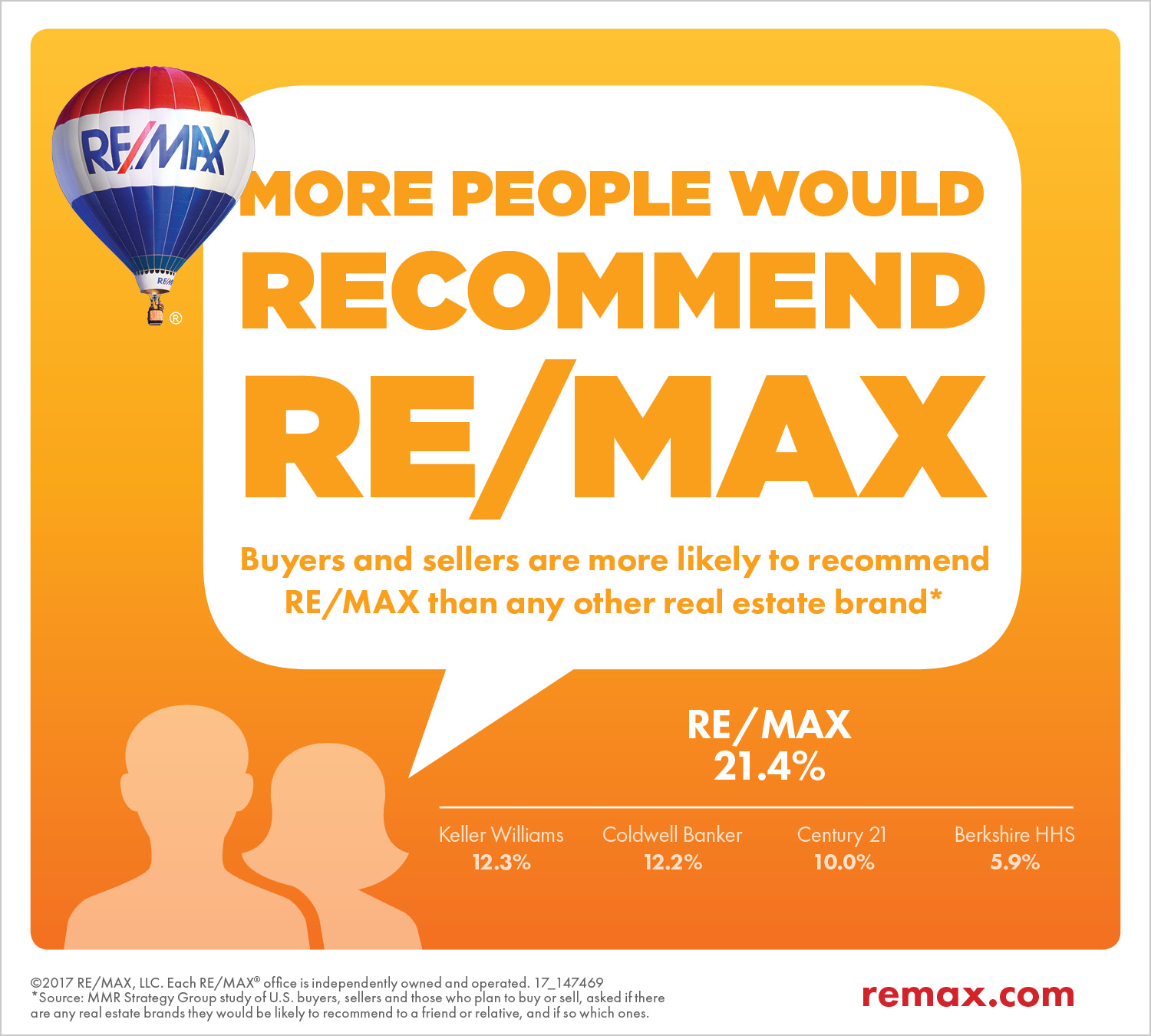
RE/MAX agents are known for providing superior service to their clients. And in the real estate industry, word gets around.  According to a recent study, home buyers and sellers are more likely to recommend RE/MAX than any other real estate brand. Experience, professionalism, results: That’s the sign of a RE/MAX agent!

Get Moving! 4 Urgent Reasons You Should Sell Your Home in 2017

Young Family

If you’ve been sitting on the fence about selling your home, it might just be time to hop off. Now. To put it in other terms: 2017 is poised to be the year of the home seller, real estate experts say. So what are you waiting for?

“Sellers have been in the driver’s seat for the last two years, but this year is shaping up to be even better for several reasons,” says Jonathan Smoke, chief economist of realtor.com®. “Nothing is bad for sellers today.”

A combination of factors is coming together to make 2017 a prime seller’s market for most of the nation. Here’s what’s driving it…

Smell Something? 7 Ways to Oust Odors

oust-odors

Whether you’re preparing for an open house or simply trying to freshen up your home, try these suggestions for getting rid of odors from seven commonly smelly items.

  1. Trash cans

After rinsing out a stinky garbage can with soap and water, stash a few scented laundry dryer sheets at the bottom to absorb odor.

  1. Freezers

An old (clean) sock stuffed with coffee grounds can absorb the musty smell in your freezer. Coffee socks can also help de-mustify stale closets. Tie one to a hanger.

  1. Litter Box

Extremely porous activated charcoal is a big-time odor absorber. Pet stores sell versions made especially for pet odors. Keep it near the litter box.

  1. Carpet

When your carpet smells icky, try sprinkling baking soda. Let it sit for half an hour, then vacuum it up.

  1. Dishwasher

Who wants to use a dishwasher that never smells quite clean? Pour white vinegar into a dishwasher safe cup and stick it in the top rack. Run the machine through its cycle. Though your kitchen will smell like vinegar for a bit, the inside of your dishwasher will soon be odor-free.

  1. Basement

If a dehumidifier doesn’t help, try adding a dozen drops of tea tree oil to a spray bottle of water and blasting the basement with this natural fungicide.

  1. Refrigerator

Clear out smell by wiping down the wall with hydrogen peroxide.

Making sure your home smells fresh is just one of the critical things to do before an open house. I’ll be happy to suggest other important steps; contact me today!