Top 10 Outperforming Markets

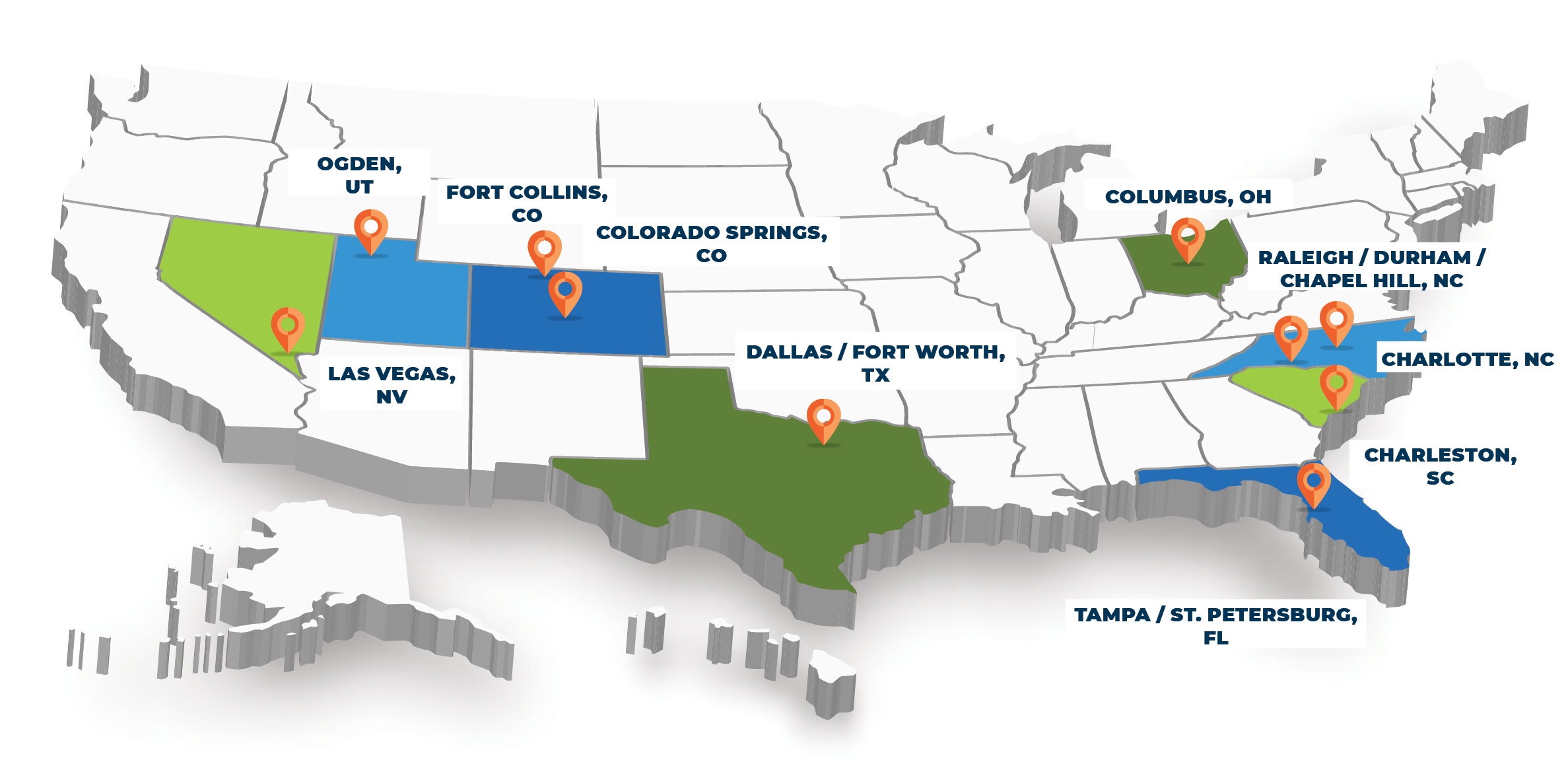
Metro Areas NAR Expects Home Price Appreciation to Outpace in the Next 3 to 5 Years

The National Association of REALTORS® identified the top metro areas taking into account a myriad of variables, including domestic migration into the area, housing affordability for new residents, consistent job growth outperforming the national average, age structure of the population, attractiveness for retirees, and the area’s home price appreciation.

In alphabetical order, the markets are:

  • Charleston, South Carolina
  • Charlotte, North Carolina
  • Colorado Springs, Colorado
  • Columbus, Ohio
  • Dallas-Fort Worth, Texas
  • Fort Collins, Colorado
  • Las Vegas, Nevada
  • Ogden, Utah
  • Raleigh-Durham-Chapel Hill, North Carolina
  • Tampa-St. Petersburg, Florida

Read more on the National Association of REALTORS® website…

5 De-cluttering Tips for Your Kitchen

Is the chaos on your countertop out of control? Here are a few tips to conquer the clutter.

  1. Use it or move it
    If you don’t use a mixer, food processor, or other tool more than once a week, stash it in a cupboard. Counter space is precious real estate.
  2. Wall-to-wall organization
    Mount a rack on your wall for storing all those things that tend to pile up on your kitchen table and counters – like mail, to-do lists and receipts.
  3. Look up
    The space on top of your wall cabinets and fridge are great places for wire baskets that let you see the contents, or fabric bins that hide things from view.
  4. What’s behind Door #1?
    Place over-the-door storage racks inside pantry doors to free up counter space.
  5. Hang ten
    Or even a dozen. Keep lightweight items such as aprons, oven mitts, large utensils and towels off counters by mounting wall hooks.

Real Estate Forecast: Recession Unlikely in 2020

Expect Continued Economic Growth, Slower Real Estate Price Gains and Small Chance for Recession in 2020, According to Group of Top Economists


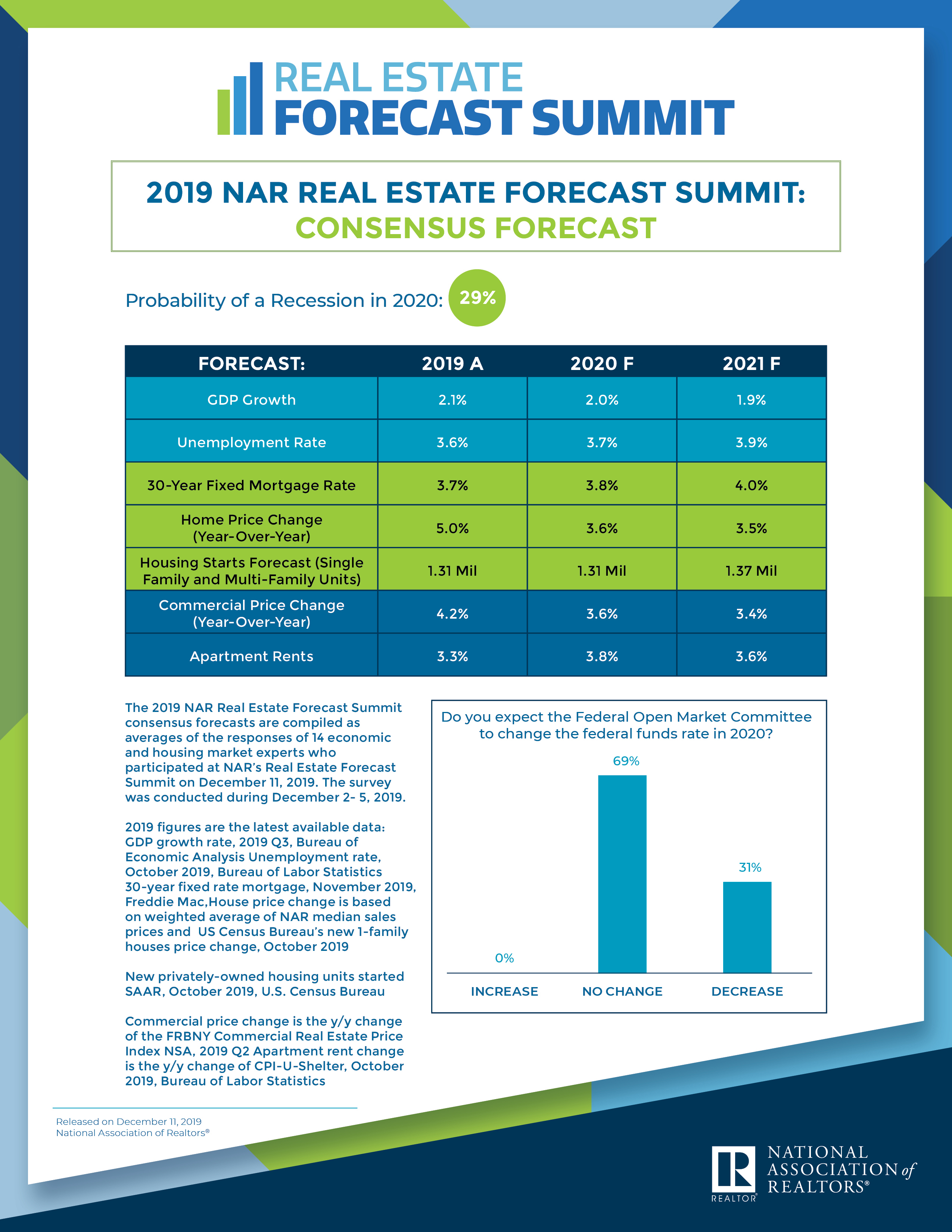
A group of top economists recently arrived at a consensus at the 2020 economic and real estate forecast at the National Association of Realtors®’ first-ever Real Estate Forecast Summit. The economists who gathered at NAR’s Washington, D.C. headquarters expect the U.S. economy to continue expanding next year while projecting real estate prices will rise and reiterating that a recession remains unlikely.

These economists predicted a 29% probability of a recession in 2020 with forecasted Gross Domestic Product growth of 2.0% in 2020 and 1.9% in 2021. The group expects an annual unemployment rate of 3.7% next year with a small rise to 3.9% in 2021.

When asked if the Federal Open Market Committee will change the federal funds rate in 2020, 69% of the economists said they expect no change, while 31% expect the committee will lower the rate next year.

The average annual 30-year fixed mortgage rates of 3.8% and 4.0% are expected for 2020 and 2021, respectively. Annual median home prices are forecasted to increase by 3.6% in 2020 and by 3.5% in 2021.

“Real estate is on firm ground with little chance of price declines,” said NAR’s Chief Economist Lawrence Yun. “However, in order for the market to be healthier, more supply is needed to assure home prices as well as rents do not consistently outgrow income gains.”

Apartment rents are expected to rise 3.8% and 3.6%, respectively, in 2020 and 2021. According to the group of economists, annual commercial real estate prices will climb 3.6% in 2020 and 3.4% in 2021.

“Residential and commercial real estate investment remains attractive as we approach the start of a new decade,” said NAR President Vince Malta, broker at Malta & Co., Inc., in San Francisco, CA. “Increased home building can serve as a stimulator for the overall economy, and we strongly encourage more homes to be built as buyer demand remains strong.”

The 2019 NAR Real Estate Forecast Summit consensus forecasts are compiled as averages of the responses of 14 leading economists who participated during the summit. The survey was conducted from December 2-5, 2019.

The National Association of Realtors® is America’s largest trade association, representing more than 1.4 million members involved in all aspects of the residential and commercial real estate industries.

Source: National Association of Realtors 12/11/19

How a Death in a Home Affects Its Value

Death is never an easy topic, but some real estate agents have to deal with home sellers who disclose a grim past and wonder if the property’s history will take its toll and leave them with fewer dollars in their account. So, yes, death has an unsuspected impact on real estate and like many, you would like to find the value of a house after death.

Read the article on RealEstateAgent.com…

Kitchen Hoods That Steal the Spotlight

In the kitchen, the spot for the range hood is considered prime real estate. Homeowners used to put the microwave there. But that’s getting swapped out for a decorative hood, which can come in a range of metals.

Read the article on REALTOR® Magazine

FHA Updates Condo Rules

FHA updates condo rules that should boost financing options on condos

Long-awaited updates to Federal Housing Administration condo rules will take effect October 15, 2019 under revised guidelines issued last month. Housing officials praised the change, saying the FHA loan program will now be more “flexible and responsive to market conditions.”

FHA said it is bringing back spot approvals and taking other steps to loosen requirements for FHA-insured condominium financing. The move is expected to allow more buyers to obtain low downpayment mortgages on affordable housing options.

An estimated 20,000 to 60,000 more condo units per year are expected to qualify for financing, according to the FHA. That represents a substantial increase from current provisions, with only 6.5% of the more than 150,000 condo projects approved for FHA financing.

Once implemented, the guidelines will mean an individual condo unit in a building of 10 units or more may be eligible for spot approval if no more than 10% of the units are FHA-insured. In smaller buildings, with fewer than 10 units, no more than two units can be FHA-insured.

The new rules will also:

  • Extend FHA certifications on condo developments from two years to three years, reducing the compliance burden on condo boards.
  • Insure more mixed-use projects so approved projects can now have up to 35% of their square footage dedicated to commercial or other non-residential uses.
  • Loosen restrictions on owner-occupancy rules, allowing projects to be just 50% owner-occupied.
  • Allow for single-unit mortgage approvals-often known as spot approvals-which will enable FHA insurance of individual condo units, even if the property does not have FHA approval.
  • Secure additional flexibility in the ratio of investors to owner-occupants allowed for FHA financing in a condo building.

NAR President John Smaby applauded the ruling, saying it culminates years of collaboration between NAR and the Department of Housing and Urban Development (HUD). He expects the ruling will help reverse recent declines in condo sales.

“Condominiums are often the most affordable option for first-time home buyers, small families, and those in urban areas,” Smaby noted.

FHA Commissioner Brian Montgomery said the agency has been working alongside stakeholders for three years to update its condo policies. NAR has sought rules changes since 2008, specifically to allow the owner-occupancy level to be determined on a case-by-case basis, and to extend the approval period for project certification to five years.

“It had become clear for many years that we needed to update our condo project approval regulations so that, while not exposing the agency to more risk, they are more flexible and less prescriptive and more reflective of the current market than the previous condominium project approval provisions,” Montgomery said on a call with reporters and the HUD secretary.

“This new rule allows FHA to meet its core mission to support eligible borrowers who are ready for homeownership and are most likely to enter the market with the purchase of a condominium,” added Montgomery, who is also HUD Acting Deputy Secretary.

In a press release announcing the updates, HUD stated, “In an effort to promote affordable and sustainable homeownership, especially among credit-worthy first-time buyers, the Federal Housing Administration (FHA) today published a long-awaited final regulation, and policy implementation guidance, which establish a new condominium approval process.”

Source: NW REporter 9/9/19

Buyers Give Fireplaces the Cold Shoulder

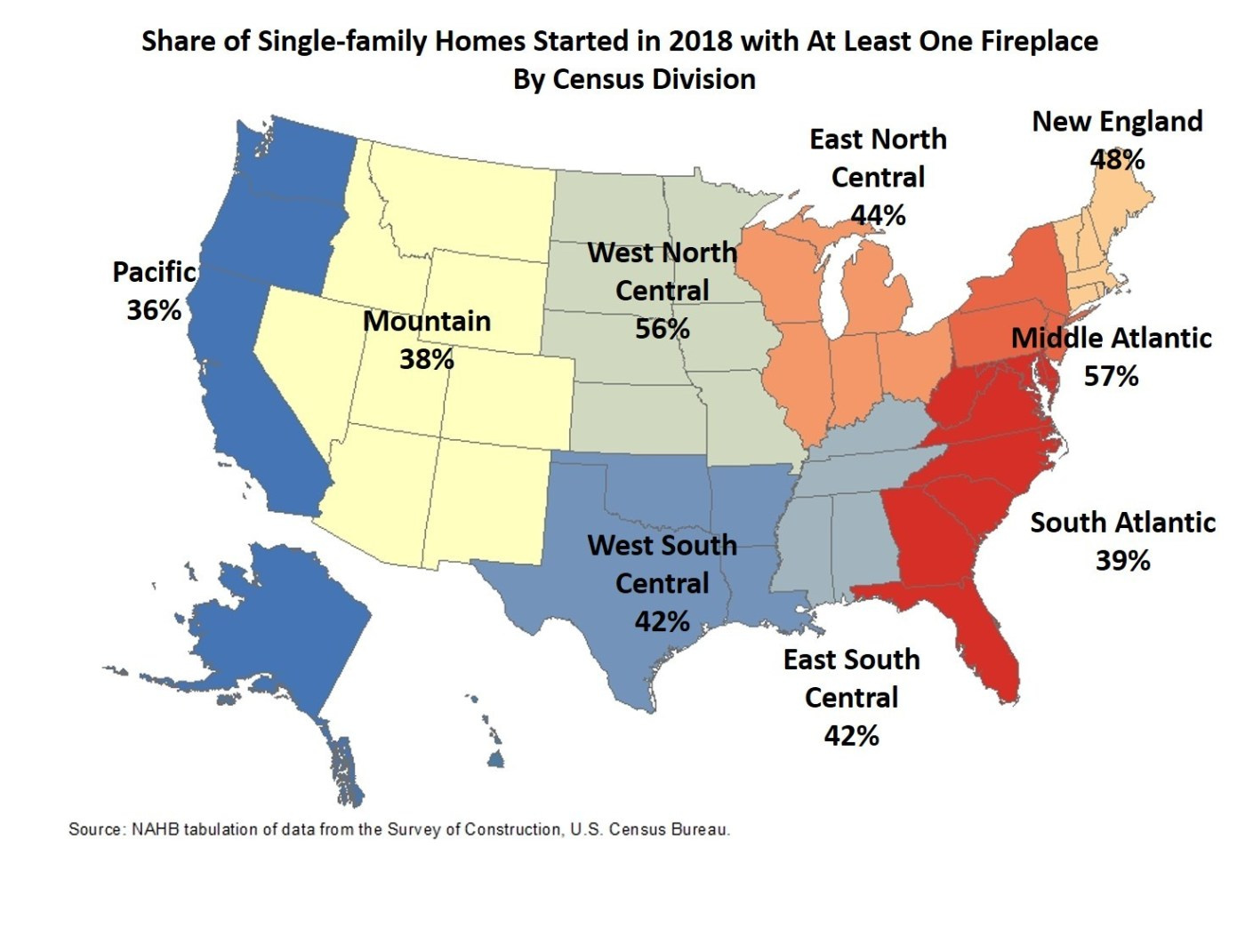
Fewer new homes are being built with a fireplace, a sign the cold-weather amenity is falling out of favor with home buyers. A record low percentage of newly constructed single-family homes—41%—last year included a fireplace, according to an analysis of U.S. Census Bureau data from the National Association of Home Builders. The share of single-family homes with fireplaces has been declining since 2015, the NAHB reports.

“An obvious explanation for the declining trend is that builders are foregoing fireplaces in some of their homes so they can bring them in at prices their customers can afford,” the NAHB reports on its Eye on Housing blog. “Keeping new homes affordable has become a considerable challenge lately.”

Fireplaces are usually considered a desirable amenity but not a must-have, the NAHB notes. Fifty-five percent of buyers rate gas-burning fireplaces as desirable, while 48% say the same of wood-burning fireplaces as desirable, according to the survey. That places such features in the middle of the list of decorative features most sought-after in terms of desirability, according to the NAHB’s “What Home Buyers Really Want” survey. However, only 16% of buyers say either type of fireplace is essential in a home purchase.

Fireplaces are the most uncommon home feature in the lower price points of the market. For example, just 7% of new single-family homes started in 2018 that were priced under $150,000 had fireplaces. On the other hand, more than 60% of homes priced at $500,000 or above had a fireplace.

Source: “Share of New Homes With Fireplaces Drop to Record Low,” National Association of Home Builders’ Eye on Housing blog (9/16/19)

2019 Real Estate in a Digital Age

Did you know that the three most popular information sources home buyers used in the home search were:

  • Online website (93%)
  • Real estate agent (86%)
  • Mobile/tablet website or app (73%)

Outdoor Kitchens Continue to Be Major Draw

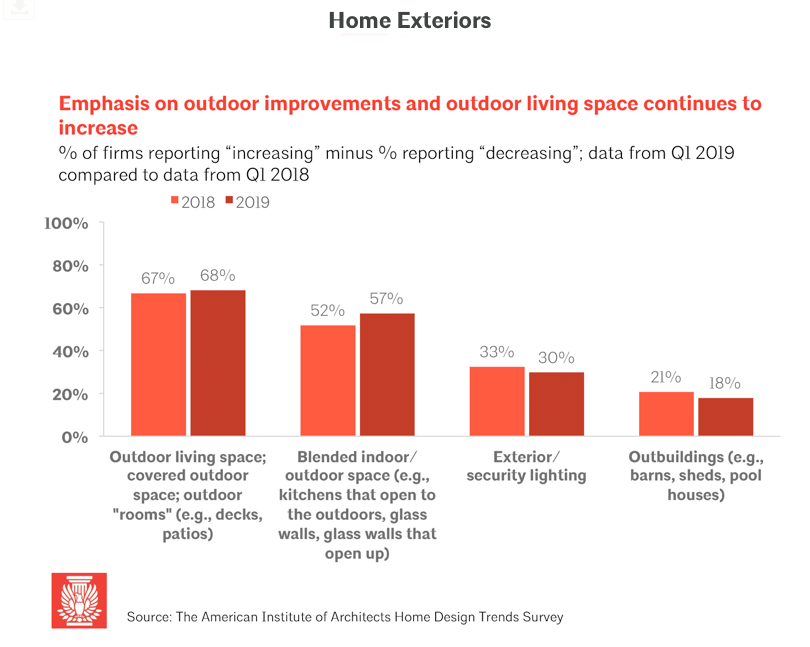
The appeal of outdoor living continues to be important to homeowners, and the outdoor kitchen is at the center of that. The latest American Institute of Architects Home Design Trends Survey shows that outdoor kitchens are among the most wanted kitchen features in new architectural projects.

Nearly 50% of the architect respondents surveyed reported the popularity of outdoor kitchens is still growing. The popularity is seen in markets across the country, and not just in warmer climates like Florida, Texas, and California—outdoor kitchens are also taking hold in colder areas like the Northeast.

Read more in REALTOR® Magazine…

Higher-end Homes Hit by Excise Tax Rate Increase

Sellers of higher-end homes will pay more in real estate excise tax (REET) next year due to changes adopted by the Washington state Legislature. A new graduated tax, or tiered REET, will go into effect for homes sold on or after January 1, 2020.

Washington state has one of the highest real estate “transfer tax” rates in the country, according to a study by the National Association of REALTORS®. That rate will now be higher for sellers of homes valued at slightly over $1.5 million or more. The current single rate REET is assessed at 1.28% on the sale price of the home. In addition, most local governments in the state assess an additional one-half percent on the sales price, making the current effective rate 1.78%.

Under the new system, effective in 2020, the first $500,000 of value will be taxed at a new reduced state rate of 1.1%, saving the seller of a $500,000 home $900. For the value of the sale between $500,000 and $1,500,000, the tax rate remains 1.28%. For the value of the sale between $1.5M and $3M the rate is 2.75 % and for sales above $3M the rate is 3%. Because the tax is assessed at a marginal rate (the different rates apply on each portion of the sale), the actual break even point between the old and the new rates is $1,561,224 of value. Sales greater than that amount will pay more REET under the new system and sales under that amount will pay less.

The local government REET rates do not change and remain in effect. The combined state and local taxable rate is shown in the table above.