How to Stage a House for Free: 7 Ideas That Don’t Cost a Dime

One of the most common mistakes sellers make is assuming they need to sink a bunch of money into home staging. Some choose the expensive route—swapping out their furniture and art at the behest of a hired professional home stager—but that’s not the only way to impress potential buyers.

“Everyone needs to stage their home to sell it efficiently,” says Laura McHolm, co-founder of NorthStar Moving. “But you do not need to spend a lot of money to stage your home.”

Want to get your house in tiptop shape without spending a dime? Follow these home staging ideas that are 100% free.

Source: Realtor.com

November 2018 Housing Affordability Index

At the national level, housing affordability is down from last month and down from a year ago. Mortgage rates rose to 4.99 percent this November, up 19.1 percent compared to 4.19 percent a year ago.

  • Housing affordability declined from a year ago in November moving the index down 10.6 percent from 161.0 to 144.0. The median sales price for a single family home sold in November in the US was $260,500 up 5.0 percent from a year ago.
  • Nationally, mortgage rates were up 80 basis point from one year ago (one percentage point equals 100 basis points).
  • The payment as a percentage of income was up from last month at 17.4 percent this November and up from 15.5 percent from a year ago. Regionally, the West has the highest payment at 23.8 percent of income. The Northeast had the second highest payment at 17.1 percent followed by the South at 16.8 percent. The Midwest had the lowest payment as a percentage of income at 13.7 percent.

Read the full article…

The 2019 Color of the Year Is…

Expect to see more coral hues in home design next year. Pantone, the corporation known for its paint forecasts, unveiled “Living Coral” as its 2019 Color of the Year. The color, an orange shade with golden undertones, embodies “warmth and comfort,” Pantone says.

Living Coral can make a bold statement as an accent color, and forecasters expect to see it in more shag rugs, cozy blankets, and upholstery to “create a warm, comforting, and nurturing feeling in the home.” “With its ebullient nature, Pantone’s Living Coral adds a dramatic pop of color to any room setting, whether in decorative accessories, tabletops, or on the wall,” Pantone said in a statement.

Living Coral succeeds Pantone’s 2018 Color of the Year, Ultra Violet. Other paint companies have been offering their picks for the 2019 Color of the Year. Behr chose a rich, bluish hue called “Blueprint,” while Sherwin-Williams chose “Cavern Clay,” a warm terra cotta color.

Source: Pantone

5 Millennial Real Estate Trends in 2019

More millennials are pursuing homeownership now than ever before. The national homeownership rate rose to 64.4 percent in the third quarter this year—an increase of half a percentage point over a year ago, according to the U.S. Census Bureau. That’s largely attributed to the rise in new, first-time home buyers.

As 2018 comes to a close, Dana Bull, an agent with Sagan Harborside Sotheby’s International Realty who has significant experience working with millennial clients, shares five trends to expect from this generation of buyers in the coming year.

1. Rising Interest Rates Will Prompt Buyers to Change Strategy
Just last week, mortgage rates rose to a seven-year high, with 30-year fixed-rate mortgages averaging 4.94 percent. It’s more than likely that rates will climb over 5 percent in the new year. This will cause many buyers to pause and reevaluate their purchasing power and strategy, Bull says. “Even a quarter point has a real impact on housing affordability,” she says. This means you’ll need to take more time to help clients analyze deals and understand what their money can buy in this shifting market.

2. Increased Competition From Baby Boomers for Properties
As millennials age and grow in their careers, they are acquiring more purchase power. According to the 2018 National Association of REALTORS® Home Buyer and Seller Generational Trends Report, 30 percent of millennials purchased homes for $300,000 and higher in the past year, up from 14 percent in 2013. That means millennials and boomers are going head-to-head for the same homes today. That trend is only going to continue to grow in 2019, Bull predicts. Both groups also seek similar amenities, including walkable neighborhoods and smaller home sizes with more upgrades, she points out. “Buyers in different generations—with wildly different points of view—are competing for the same homes,” she says. “For sellers and agents, catering to two different generations in marketing homes will also be a challenge.”

3. Willing to Put In Sweat Equity
Millennials are becoming more savvy to renovations and repairs, and they may have HGTV to thank for that, Bull says. “Millennial buyers are still far more aware of the work, costs, and implications of a renovation than their parents would have been,” she says. “Popular TV shows mean a more educated millennial buyer who knows what to look for in terms of red flags. But also has more confidence around renovating a home to make it their own and the ability to see past outdated wallpaper or a wall that can be easily removed.” Keep this in mind as interest rates continue to rise in 2019 (re: trend number one) and you’re helping clients who want to get creative while staying in their price range.

4. Clients Who are Well-Researched and Prepared 
Millennial buyers are doing their online research and are entering the market well-prepared. Show your value as a REALTOR® in other ways, Bull recommends. “They are relying on real estate professionals not to introduce them to homes, most of which they can find online, but to show them what can’t be researched: neighborhoods that are up and coming, which properties stand to gain value in the coming years, and guidance when it comes to negotiations and inspections.”

5. Social Media’s Continued Impact
Social media will continue to influence millennials’ homebuying habits, Bull says. This generation relies heavily on online reviews and social media presence to make purchasing decisions. A strong online reputation for real estate professionals is a must in catering to this market, she adds. Showcasing homes on social media—particularly Instagram—is essential for appealing to millennial clients.

Source: REALTOR® Magazine

Americans Shift Their Perceptions of the Housing Market

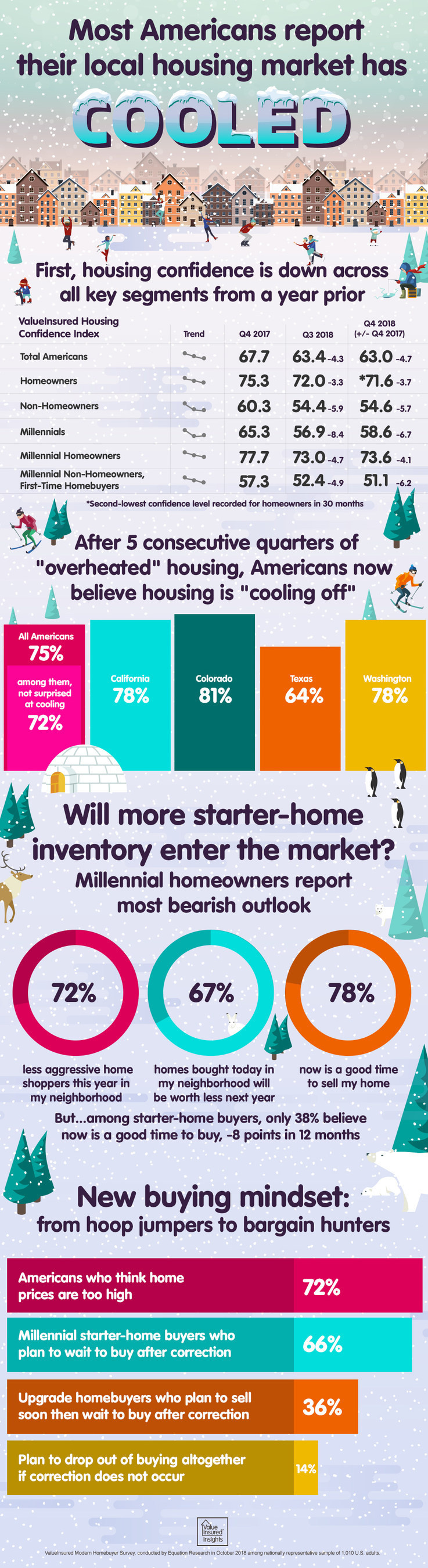
For the past five quarters, the majority of Americans said their housing markets were overheating. Now, in the fourth quarter, 75 percent of Americans say their local housing market is starting to cool, according to ValueInsured’s Q4 2018 Modern Homebuyer Survey. Homeowners in California, Colorado, Texas, and Washington are most likely to say their local market is starting to cool off.

The survey “revealed some concerning evidence about the changing psychology of the housing market,” says Robert Shiller, a housing economist. “We will be watching these numbers as they unfold over the future.”

Seventy-two percent of Americans and 78 percent of “urban residents” say home prices are still too high. Urban homeowners blame “flippers and speculative investors” and “wealthy transplants from more expensive housing markets” for inflating their local home prices to unsustainable levels, according to the report.

Some home buyers may hit the pause button to see what happens in the housing market. Fifty-nine percent of interested home buyers (which includes first-time and move-up buyers) say they plan to wait for a “meaningful correction” before they buy. Fourteen percent say they plan to not buy at all until a correction occurs.

Several markets are seeing home prices slow. ValueInsured’s report notes that the fastest drops in home prices have been happening in Seattle, and North Texas has seen some of its largest sales declines in seven years.

“Buyers have switched from ‘hoop jumpers’ to bargain-hunter mode,” says Joe Melendez, CEO and founder of ValueInsured.

Source: REALTOR® Magazine

Market Shifting to Buyers’ Favor

A housing market defined by rapidly rising home prices, bidding wars, a lack of inventory, and sellers with the upper hand in negotiations may be changing. “The signs are pointing to a market that’s shifting toward buyers,” says Danielle Hale, realtor.com®’s chief economist. “But in most places, we’re still a long way from a full reversal.”

After all, home sales aren’t exactly tanking. Prices for existing homes were up 4.6 percent from a year ago in the National Association of REALTORS®’ latest housing report. The median home list price in August was up 7 percent from last year.

While these numbers are still higher than last year, economists point to a slowing growth in the percentage jumps. Last year, median home list prices increased by 10 percent from the previous year and by 9 percent the year before that.

A recent report from real estate brokerage Redfin showed that more than one in four home sellers dropped their asking price last month. The areas seeing some of the biggest decreases this year are Las Vegas; San Jose, Calif.; Seattle; and Atlanta.

“We’ve hit that tipping point in a lot of these cities where what sellers think they can get is just not possible for many buyers,” Daren Blomquist, senior vice president at ATTOM Data Solutions, told realtor.com®. “Now the pendulum is swinging away from sellers and back toward buyers.”

Economists point to housing affordability as a culprit for the slowdown. Mortgage rates are up 0.82 percent since a year ago; the 30-year fixed-rate mortgage averaged 4.65 percent as of Sept. 20. Each percentage point increase in rates can translate to about $143 more on a monthly mortgage payment, or nearly $51,500 over the life of a loan on a $300,000 priced home, according to realtor.com®.

“Home prices have just gone up too fast,” Blomquist says. “It doesn’t mean that all of a sudden it’s a market that’s going to crash. But it does mean there are limits to what people can afford.”

Fewer Americans Are Willing to Move for a Job

Fewer Americans are willing to uproot their lives to move for new job opportunities, suggests new census data.

About 3.5 million Americans relocated for a new job last year, a 10 percent drop from 3.8 million in 2015. The number has been trending lower, despite the overall population increasing 20 percent over that time, The Wall Street Journal reports.

Why are more people staying put? Experts told WSJ that some blame may rest on rebounding real estate values. Housing costs have soared higher in some regions where jobs may be more plentiful, like East and West Coast cities, but it may be pricing out some who may have otherwise been willing to relocate.

Read the full article on REALTORmagazine

No Housing Recession Over the Horizon

Media reports are increasingly focused on whether a major home sale slowdown, or maybe even a crash, is in the making, in part because many hot housing markets are seeing slackening buyer demand, and nationally 2018 is expected to end with fewer home sales than 2017. But the possibility of a crash is unlikely, says Lawrence Yun, chief economist for the National Association of REALTORS®.

In a piece he contributed to Forbes, Yun says hot markets are seeing a slowdown not because of weak buyer demand, which could be an indicator of a true slowdown, but insufficient supply. When homes come on the market, especially in areas like Seattle and Denver that have strong job growth and little unemployment, they are typically snapped up.

In other positive signs, home price growth remains strong in markets across the country—about 5 percent on a nationwide basis so far this year—and there are no signs of the credit excesses that characterized the housing crisis 10 years ago. “Lending standards today are still stringent, as evidenced by the higher-than-normal credit scores of those who are able to obtain a mortgage,” Yun says. “That is why mortgage default and foreclosure rates are at historic lows.”

In short, Yun says, today’s housing problem stems from insufficient inventory. The supply problem is driving up home prices and worsening affordability and keeping sales from matching demand. That is a serious problem and the answer is to encourage builders to increase supply, Yun says, but it is not a prelude to a crash.

Source: “No Housing Recession Over Horizon,” Forbes.com

Has the Inventory Crunch Begun to Subside?

Contract signings rose in all four major regions across the U.S. last month, a sign that dwindling home sales—which have plagued the market at an unusual time of year this summer—will reverse course in the coming months, the National Association of REALTORS® reports.

NAR’s Pending Home Sales Index, a forward-looking indicator based on contract signings, increased 0.9 percent month over month in June to a reading of 106.9. “After two straight months of declines in pending home sales, home shoppers in a majority of markets had a little more success finding a home to buy last month,” says NAR Chief Economist Lawrence Yun. “The positive forces of faster economic growth and steady hiring are being met by the negative forces of higher home prices and mortgage rates. Even with slightly more homeowners putting their home on the market, inventory is still subpar and not meeting demand. As a result, affordability constraints are pricing out some would-be buyers and keeping overall sales activity below last year’s pace.”

Despite last month’s rise, contract signings are still down 2.5 percent compared to a year ago, NAR reports. Nevertheless, Yun says the worst of the supply crunch may now have passed. In June, existing inventory was up slightly on an annual basis, marking the first increase in three years. Several large metros saw year-over-year surges in inventory levels last month:

  • Portland, Ore.: +24 percent
  • Providence, R.I.: +20 percent
  • Seattle: +19 percent
  • Nashville, Tenn.: +17 percent
  • San Jose, Calif.: +15 percent

“Home price growth remains swift, and listings are still going under contract at a robust pace in most of the country, which indicates that even with rising inventory in many markets, demand still significantly outpaces what’s available for sale,” Yun says. “However, if this trend of increasing supply continues in the months ahead, prospective buyers will hopefully begin to see more choices and softer price growth.”

Source: National Association of REALTORS®

3 Bathroom Trends Homeowners Might Want to Avoid

Bathroom makeovers can help enhance a property, but homeowners should be careful not to be too trendy or it may have the opposite effect. HouseLogic detailed several recent bathroom trends that homeowners might want to reconsider, including:

Tiny tiles

Mosaics of tiny colored tiles may be on-trend and offer a retro vibe to your bathroom, but they’ve also earned a reputation as being a pain to keep clean. Tiny tiles mean more grout to clean and maintain. Instead of doing a large space of tiny tiles, HouseLogic recommends using them as an accent, such as the wall surrounding your vanity. Choose a place where they won’t get wet on the floor, in the tub, or in the shower so that cleaning them is less of a chore.

Hardwood floors

The flooring may be a hot choice for the rest of your home, but they can be a pain in the bathroom. “It will warp next to a shower or tub if not dried after each use,” Tanya Campbell, a designer for Virdis Design Studio in Denver, told HouseLogic. “Also, tile is more sanitary.” If the wooden look is what you want, opt for something that resembles the exterior, but is actually tile.

Colored tubs and sinks

Color is gradually entering more bathrooms. But don’t forget the lessons from the 1950s pastel bathroom craze that brought in pink and aqua sinks. That had renovators ripping them out a few years later in favor of white, a safer choice for the long term. “The bathroom is one of the most expensive rooms in the house to do, and so I try to be very safe because the parts are going to be expensive to change out—like a tub,” Suzanne Felber, a designer in Dallas, told HouseLogic. If color is what homeowners want, opt for painting the walls instead; it’s easier to change later on.

Catch more bathroom trends worth reconsidering at HouseLogic.com.