Shutdown Will Stall Home Loans for Thousands

Beginning this week, thousands of home buyers will be unable to get approvals for their mortgages because of the government shutdown, potentially undercutting the nation’s resurgent housing market.

Without paperwork from the Internal Revenue Service, the Social Security Administration and in many cases the Federal Housing Administration, banks and other mortgage lenders will be less willing to make loans, if they can make them at all. For instance, lenders rely on the IRS to confirm borrowers’ income and on Social Security to confirm their identity.

Every day that government offices remain shuttered will delay an ever-larger fraction of mortgage closings, industry leaders say, jeopardizing mortgage and interest-rate approvals and spooking sellers. About 15,000 new home mortgages and 18,000 refinancings on average are completed across the country each day.

Read more…

Good News for Owners of Smaller Residential Rental Properties

A recent column (“IRS finally provides guidance on building repairs vs. improvements“) explained that the IRS has finally issued the final version of its monumentally long and complex regulations explaining how to deduct improvements and repairs to business property, including commercial buildings and residential rentals.

The final regulations, which take effect Jan. 1, 2014, contain several pleasant surprises for small-business owners, including owners of rental properties. One of these is the “safe harbor for small taxpayers” (IRS Reg. 1.263(a)-3h).

This new reg allows a qualifying taxpayer to elect to not apply the IRS’s complex new improvement regs to an eligible building if the total amount paid during the year for repairs, maintenance, improvements and similar expenses does not exceed the lesser of $10,000 or 2 percent of the unadjusted basis of the building (usually, its cost).

Read the details…

Homes Near Public Transit Worth More

Homes close to public transportation are worth more than similar properties that don’t have nearby access to subways, rail lines, or buses, according to a study commissioned by the American Public Transportation Association and the National Association of REALTORS®.

Researchers evaluated five years worth of sales data in several major metros with various public transportation options. They found that homes located within a half-mile of public transportation were valued 41 percent higher than properties located outside that area.

“Transportation plays an important role in real estate and housing decisions, and the data suggests that residential real estate near public transit will remain attractive to buyers,” says Lawrence Yun, NAR’s chief economist. “When consumers choose a home, they also choose a lifestyle. Shorter commutes and more walkable neighborhoods matter to a growing number of people, especially those living in congested metro areas.”

Read the details…

3 Rent vs. Buy Market Myths

Calculator

To rent or to buy? That is the question. Well, at least for many buyer prospects.

Buyers are sometimes stunned at the number of potentially life-changing decisions and choices they are required to make over the course of a house hunt. This neighborhood or that one?  Condo or single family? Fixer or move-in ready? Is that the right house? How much to offer, and on what terms? When to make an offer?  Whether to remove contingencies?

And that’s just the short list. Read more…

As Mortgage Refi Boom Dries Up

…lenders are loosening requirements for homebuyers.

Credit Accessibility

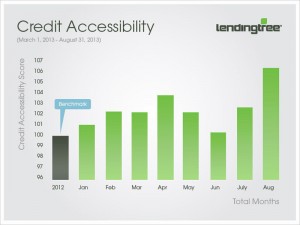
Online mortgage originator LendingTree’s monthly Credit Accessibility Report shows the average accessibility score for U.S. borrowers rose from 103 to 106 between July and August, indicating that borrowers had easier access to mortgage credit.

The Credit Accessibility score is benchmarked at 100, using data from the full year of 2012, which is where it stood in June.

Read more…

Bigger Mortgage Rates, Smaller Homes?

As the costs of mortgages get bigger, could the size of homes buyers purchase get smaller?

According to financial Web site The Motley Fool, interest rates and home size are closely tied together. “As interest rates fell in the late 1970s, home sizes grew,” Motley Fool reports. “As rates rocketed in the early 1980s, home sizes contracted. After reaching a peak in the 1980s, mortgage rates have fallen precipitously, and homes have grown in almost every single year since.”

Read more…

Where Home Sellers Fared the Best This Summer

As the summer home buying season wraps up, realtor.com® reports which markets fared the best.

For home sellers who listed their homes in April, they tended to have the best chance to receive multiple offers as well as the shortest time on the market, according to realtor.com®. 

Over the season, inventory levels increased, adding greater competition to the field and slowing the appreciation of prices in the majority of housing markets. 

Realtor.com® compiled a list of the “Top 10 Housing Markets Where Home Owners Wish They’d Listed in April,” which includes housing markets that saw the largest jumps in inventory from April to August.

Read more…

Fall Gardening Advice Worth Cultivating

Fall
Fall can be a focal time for your garden. Rather than pruning back perennials and cleaning up tools, take some time to scrutinize your entire outdoor environment. Here are four areas that may help your garden get a jump on spring…

Seattle Ranks 4th Among Best Tech Regions in U.S.

Laptop

The Seattle-Puget Sound area is the fourth best tech region in the nation, according to real estate firm Jones Lang LaSalle. Three areas around San Francisco led the rankings. Portland was 16th.

In its third annual high-tech office outlook, JLL compared 26 markets using four primary factors:

  • overall high-tech employment
  • amount of venture capital funding
  • number of patents
  • number of tech workers as a percentage of people with college degrees

A company representative said employment metrics are weighted most heavily in its rankings.

Read more…

Why hasn’t the inventory shortage fueled more home construction?

Ever wondered why, in the face of a sharp inventory shortage, new home construction still lags so far behind other housing indicators? According to Trulia Chief Economist Jed Kolko, there are two reasons…