Market Shifting to Buyers’ Favor

A housing market defined by rapidly rising home prices, bidding wars, a lack of inventory, and sellers with the upper hand in negotiations may be changing. “The signs are pointing to a market that’s shifting toward buyers,” says Danielle Hale, realtor.com®’s chief economist. “But in most places, we’re still a long way from a full reversal.”

After all, home sales aren’t exactly tanking. Prices for existing homes were up 4.6 percent from a year ago in the National Association of REALTORS®’ latest housing report. The median home list price in August was up 7 percent from last year.

While these numbers are still higher than last year, economists point to a slowing growth in the percentage jumps. Last year, median home list prices increased by 10 percent from the previous year and by 9 percent the year before that.

A recent report from real estate brokerage Redfin showed that more than one in four home sellers dropped their asking price last month. The areas seeing some of the biggest decreases this year are Las Vegas; San Jose, Calif.; Seattle; and Atlanta.

“We’ve hit that tipping point in a lot of these cities where what sellers think they can get is just not possible for many buyers,” Daren Blomquist, senior vice president at ATTOM Data Solutions, told realtor.com®. “Now the pendulum is swinging away from sellers and back toward buyers.”

Economists point to housing affordability as a culprit for the slowdown. Mortgage rates are up 0.82 percent since a year ago; the 30-year fixed-rate mortgage averaged 4.65 percent as of Sept. 20. Each percentage point increase in rates can translate to about $143 more on a monthly mortgage payment, or nearly $51,500 over the life of a loan on a $300,000 priced home, according to realtor.com®.

“Home prices have just gone up too fast,” Blomquist says. “It doesn’t mean that all of a sudden it’s a market that’s going to crash. But it does mean there are limits to what people can afford.”

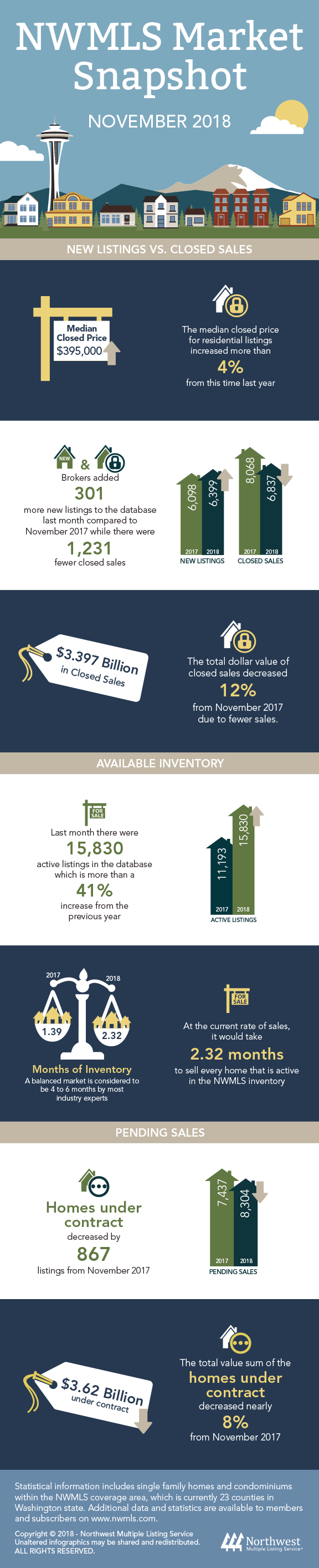
Washington State NWMLS Market Snapshot for September 2018

Balance is finally returning to the housing market as buyers welcome more choices and moderating prices.

August 2018 RE/MAX National Housing Report

Home Sales Decline 1% as Inventory, Prices Level Out

The RE/MAX National Housing Report for August 2018 shows increasing home prices, low inventory and a reduction in days on market. These combined factors made August 2018 the sixth time this year that home sales lagged behind last year’s pace—but only slightly at -1.1%.

Home prices rose by 3.7% over August 2017, much lower than the year-over-year price increase of 5.4% from August 2016 to August 2017. In fact, the past three months of 2018 have trailed 2017’s rate of price growth year-over-year—compare that to four of the first five months of 2018 when year-over-year price increases easily topped those posted in 2017.

The Median Sales Price of $248,500 marked the 29th consecutive month of year-over-year price increases.

Even though active inventory dropped for the 118th consecutive month, the decline of 5.4% from August 2017 marked the smallest year-over-year decrease since August 2014. In addition, the August 2018 inventory drop marked the fourth consecutive month in 2018 to post single-digit percent declines, rather than the double-digit monthly drops consistently seen in early 2018 and over the previous three years.

Read the full article in RE/MAX’s newsroom

Watch the 40 second summary video on YouTube

Washington State NWMLS Market Snapshot for August 2018

July 2018 RE/MAX National Housing Report

Sales Increase Nearly 2%, Despite Record Prices, Sinking Inventory

July home sales rose 1.8% year-over-year, making it the second month of 2018 to post a sales increase year-over-year, according to the RE/MAX National Housing Report.

In the July 2018 report, 37 of the report’s 54 metro areas posted sales increases over July 2017—April was the first month of 2018 where more homes were sold than the same month in 2017. The report also marks the 28th consecutive month of year-over-year price increases.

The Median Sales Price of $250,575 was up 4.4% from July 2017, and represents the third-highest price in report history—topped only by May and June of this year. Months Supply of Inventory was at 2.9 – the smallest total ever recorded for July.

Forty-two of the 54 metro areas reported a year-over-year drop in inventory. The Days on Market dropped to 41 – four days less than July 2017 and one day under the previous nine-year low set in June 2018.

“Because we’ve faced challenging inventories and increasing home prices for some time now, a seasonal slowdown that rebalances the market a bit might actually be a positive in the months ahead,” said RE/MAX CEO Adam Contos. “It could level affordability to some extent and create more opportunity for buyers who’ve been priced out of hot markets.”

Read the full article in RE/MAX’s newsroom

Watch the 40 second summary video on YouTube

Washington State NWMLS Market Snapshot for July 2018

No Housing Recession Over the Horizon

Media reports are increasingly focused on whether a major home sale slowdown, or maybe even a crash, is in the making, in part because many hot housing markets are seeing slackening buyer demand, and nationally 2018 is expected to end with fewer home sales than 2017. But the possibility of a crash is unlikely, says Lawrence Yun, chief economist for the National Association of REALTORS®.

In a piece he contributed to Forbes, Yun says hot markets are seeing a slowdown not because of weak buyer demand, which could be an indicator of a true slowdown, but insufficient supply. When homes come on the market, especially in areas like Seattle and Denver that have strong job growth and little unemployment, they are typically snapped up.

In other positive signs, home price growth remains strong in markets across the country—about 5 percent on a nationwide basis so far this year—and there are no signs of the credit excesses that characterized the housing crisis 10 years ago. “Lending standards today are still stringent, as evidenced by the higher-than-normal credit scores of those who are able to obtain a mortgage,” Yun says. “That is why mortgage default and foreclosure rates are at historic lows.”

In short, Yun says, today’s housing problem stems from insufficient inventory. The supply problem is driving up home prices and worsening affordability and keeping sales from matching demand. That is a serious problem and the answer is to encourage builders to increase supply, Yun says, but it is not a prelude to a crash.

Source: “No Housing Recession Over Horizon,” Forbes.com

June 2018 RE/MAX National Housing Report

Median Sales Price Reaches Nine-Year High, While Sales Decline

Halfway through 2018, prices are at record highs, inventory is at record lows and home sales are trailing 2017’s pace, according to the RE/MAX National Housing Report.

June sales were 5.5% lower than June 2017 in the 54 metro areas surveyed, marking the seventh consecutive month of year-over-year declines.

Headed in the opposite direction, the June Median Sales Price of $258,500 was an all-time high in the nine-year history of the report. It was 5.1% higher than the $245,000 recorded last June, bringing the consecutive months of year-over-year price increases to 27. In each of the previous five years – going back to June 2013’s $193,750 – June has posted the highest Median Sales Price of the year.

Read the full article in RE/MAX’s newsroom

Watch the 40 second summary video on YouTube

Washington State NWMLS Market Snapshot for June 2018

May 2018 RE/MAX National Housing Report

Prices Rise 7.8 Percent, But Homes Selling Faster and Faster

In May, homes sold faster than at virtually any other time in the past decade, according to the latest RE/MAX National Housing Report. Low inventory and high demand in May cut Days on Market to 46, the second-lowest monthly number in the nearly 10-year history of the report.

May home sales topped April sales by 14.5%, and were down by 2.8% from May 2017. The median sales price of $251,673 was up 7.8%.

By comparison, homes averaged five more days on the market (51) in May 2017, 12 more days (58) in May 2016 and 18 more days (64) in 2015.

With 11 metro areas increasing the median sales price year-over-year by double digits, May was still a seller’s market, and homebuyers should expect to compete with other buyers when they are ready to make an offer on a home.

Read the full article in RE/MAX’s newsroom

Watch the 40 second summary video on YouTube