The Global Demand for Affordable Housing

The subject of affordable housing in cities around the world is becoming a focus of discussion as we move into the next decade. Whether it be in Los Angeles, San Francisco, London, Sydney, or Cape Town, academics, politicians, and developers are trying to solve the growing problem.

It cannot be a solution to the demand for housing in thriving cities, to move people further away from the city in search of cheaper places to live. The cultural issue is how to bring about significant increases in supply to city precincts without resorting to building on green belts and other open areas. Various cities will require the incumbent powers and political leaders to align with housing providers, new financial models, and the market to support low-cost housing essential to creating economically successful and enduring living places.

LA’S CRISIS

Los Angeles’ affordable housing crisis is well documented. According to the annual report from the California Housing Partnership, LA county would need over half a million units of affordable housing to meet the demand from low-income renters. In most major cities around the world, the price of most market-rate units is out of reach for low-income earners.

Most definitions of affordable housing are homes affordable to those entering or in the housing market but unable to access current planned or available supply either because of income circumstances or the stage of their lives.

According to the California Housing Partnership, the crisis is more significant than single communities. No matter how hard local governments and citizens work, help is needed from state, provincial, and federal authorities. A report by Savills in Britain estimated that as many as 500,000 families a year are unable to access available housing supply.

In Sydney and Cape Town, demand for affordable housing far exceeds supply. A comparison between the 20 most affordable Sydney suburbs for low-income earners in 2006, and again in 2010, found dramatic reductions in the number of affordable properties. The suburb of Westmead, for instance, recorded a 90 percent reduction in affordable properties over the period. A study done in Cape Town by a prominent architect suggests that mixed-income high-rise residential developments have the potential to break the mold. Integrating private sector investment and provision of tax breaks to developers would allow a larger budget for better aesthetics in design, giving people from a spectrum of income groups the ability to be accommodated in previously exclusive city areas. Blended buildings would provide people with inhabiting social housing units more integrity and all the inhabitants a sense of value and strong dignity.

We have a way to go before viable solutions are found to this problem, but comfort can be found in the fact that some of the most qualified people are applying their minds to solving the global affordable housing crisis.

Source: Washington REALTORS®

Top 10 Outperforming Markets

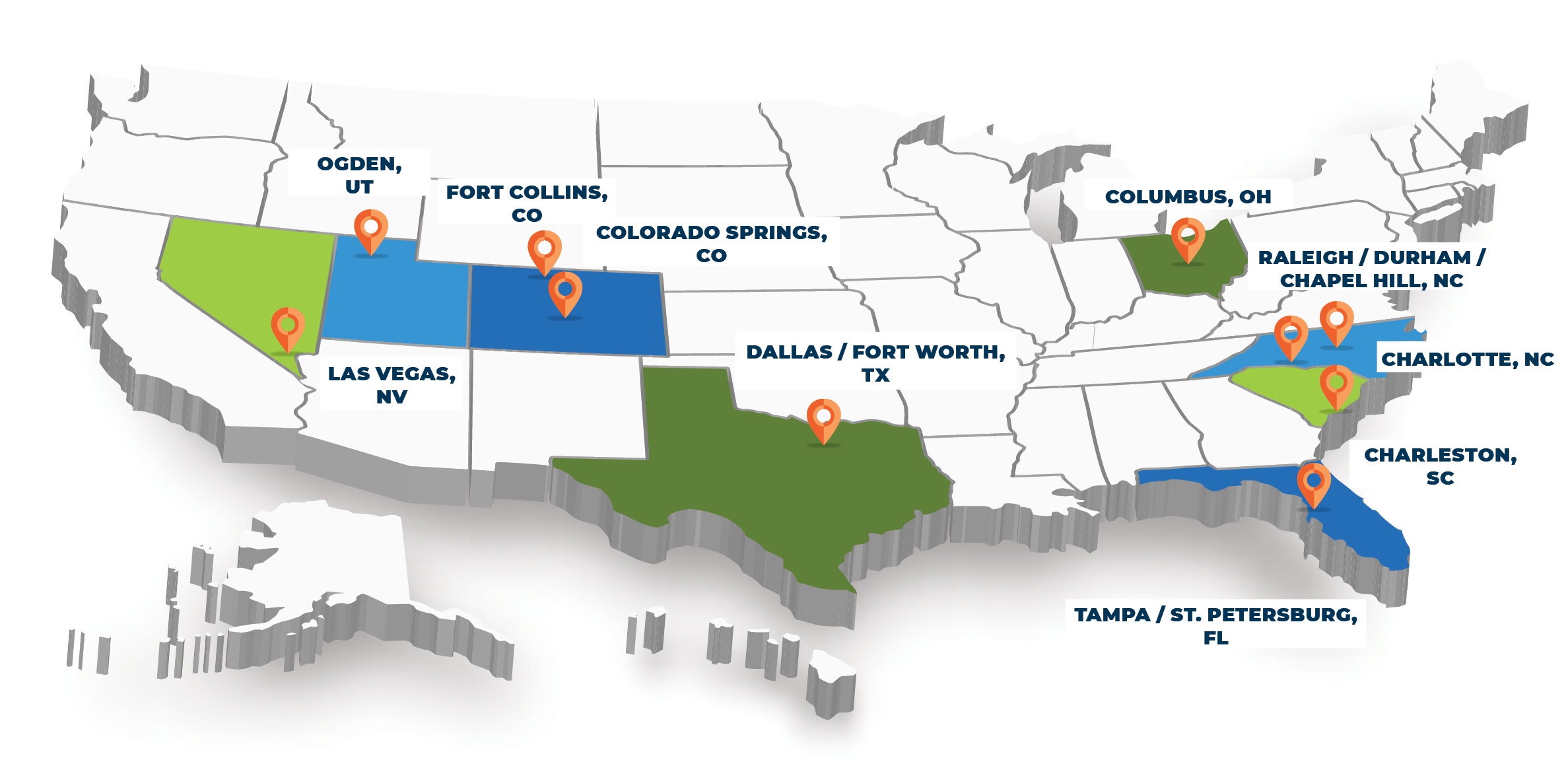
Metro Areas NAR Expects Home Price Appreciation to Outpace in the Next 3 to 5 Years

The National Association of REALTORS® identified the top metro areas taking into account a myriad of variables, including domestic migration into the area, housing affordability for new residents, consistent job growth outperforming the national average, age structure of the population, attractiveness for retirees, and the area’s home price appreciation.

In alphabetical order, the markets are:

  • Charleston, South Carolina
  • Charlotte, North Carolina
  • Colorado Springs, Colorado
  • Columbus, Ohio
  • Dallas-Fort Worth, Texas
  • Fort Collins, Colorado
  • Las Vegas, Nevada
  • Ogden, Utah
  • Raleigh-Durham-Chapel Hill, North Carolina
  • Tampa-St. Petersburg, Florida

Read more on the National Association of REALTORS® website…

Real Estate Forecast: Recession Unlikely in 2020

Expect Continued Economic Growth, Slower Real Estate Price Gains and Small Chance for Recession in 2020, According to Group of Top Economists


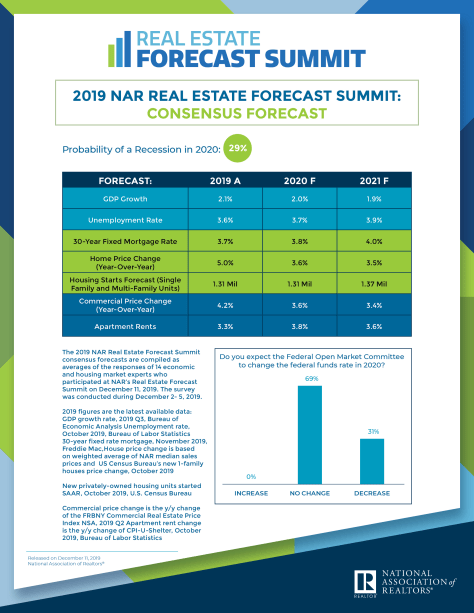
A group of top economists recently arrived at a consensus at the 2020 economic and real estate forecast at the National Association of Realtors®’ first-ever Real Estate Forecast Summit. The economists who gathered at NAR’s Washington, D.C. headquarters expect the U.S. economy to continue expanding next year while projecting real estate prices will rise and reiterating that a recession remains unlikely.

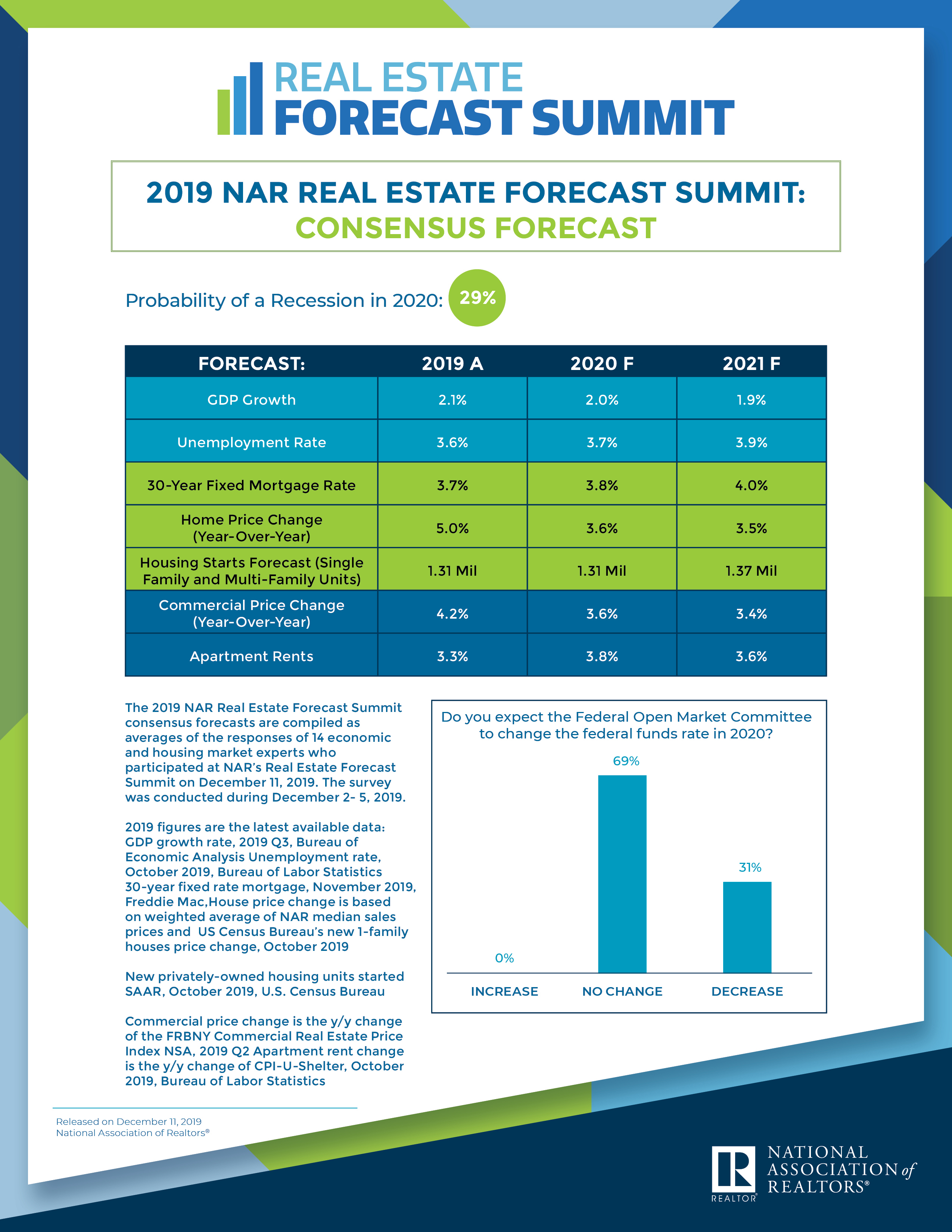
These economists predicted a 29% probability of a recession in 2020 with forecasted Gross Domestic Product growth of 2.0% in 2020 and 1.9% in 2021. The group expects an annual unemployment rate of 3.7% next year with a small rise to 3.9% in 2021.

When asked if the Federal Open Market Committee will change the federal funds rate in 2020, 69% of the economists said they expect no change, while 31% expect the committee will lower the rate next year.

The average annual 30-year fixed mortgage rates of 3.8% and 4.0% are expected for 2020 and 2021, respectively. Annual median home prices are forecasted to increase by 3.6% in 2020 and by 3.5% in 2021.

“Real estate is on firm ground with little chance of price declines,” said NAR’s Chief Economist Lawrence Yun. “However, in order for the market to be healthier, more supply is needed to assure home prices as well as rents do not consistently outgrow income gains.”

Apartment rents are expected to rise 3.8% and 3.6%, respectively, in 2020 and 2021. According to the group of economists, annual commercial real estate prices will climb 3.6% in 2020 and 3.4% in 2021.

“Residential and commercial real estate investment remains attractive as we approach the start of a new decade,” said NAR President Vince Malta, broker at Malta & Co., Inc., in San Francisco, CA. “Increased home building can serve as a stimulator for the overall economy, and we strongly encourage more homes to be built as buyer demand remains strong.”

The 2019 NAR Real Estate Forecast Summit consensus forecasts are compiled as averages of the responses of 14 leading economists who participated during the summit. The survey was conducted from December 2-5, 2019.

The National Association of Realtors® is America’s largest trade association, representing more than 1.4 million members involved in all aspects of the residential and commercial real estate industries.

Source: National Association of Realtors 12/11/19
Fannie Mae, Freddie Mac loan limit increases to more than $510,000

The Federal Housing Finance Agency recently announced that it is raising the conforming loan limits for Fannie Mae and Freddie Mac to more than $510,000.

In most of the U.S., the 2020 maximum conforming loan limit will be raised to $510,400, up from 2019’s level to $484,350.

This marks the fourth straight year that the FHFA has increased the conforming loan limits after not increasing them for an entire decade from 2006 to 2016.

Read more details on HousingWire

A Possible New Way to Fund Roads in Washington State

Washington has been exploring a potential gas tax replacement to fund our roads and bridges. Conducted by the Washington State Transportation Commission (WSTC), the test-driving phase of the Washington Road Usage Charge (WA RUC) Pilot Project ended in January 2019. Approximately 2,000 drivers participated in the year-long WA RUC Pilot Project, reported their mileage, and provided feedback to help state decision-makers understand if this potential policy could work for Washington drivers.

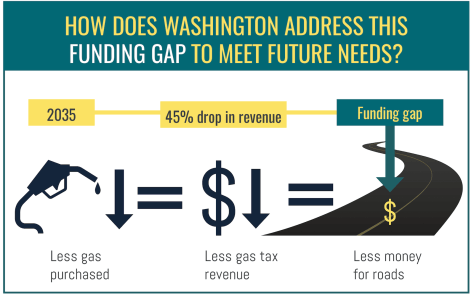
Did you know that the current gas tax of 49.4 cents per gallon is used to fund the state’s roads and bridges? As cars become increasingly more fuel efficient and as more electric vehicles are on the road, gas tax revenue used to support our roads and bridges will decrease more each year. To ensure stable, long-term funding, we need to change the way we pay for our roads.

A road usage charge (RUC) system is a per-mile charge drivers would pay based on how many miles you drive, not how much gas you consume. This approach is similar to how people pay for their utilities, including electricity or water. The WA RUC Pilot Project tested a mock 2.4-cent-per-mile road usage charge for light-weight, non-commercial vehicles including gasoline-fueled, hybrid, and electric vehicles.

Read more and watch a short informative video at WaRoadUsageCharge.org

What the Fed’s Rate Cut Means for Buyers

The Federal Reserve recently cut interest rates for the first time since the Great Recession took hold in 2008, though the move is not likely to deliver significant juice to an already favorable borrowing environment for home buyers. The federal funds rate, which is what banks charge one another for short-term borrowing, will now hover between 2% and 2.25%, according to news reports.

The Fed says its decision to lower interest rates, which comes after months of pressure from President Donald Trump, is designed to stave off the threat of an economic downturn. But it’s unlikely to translate into additional mortgage savings for many buyers. With the interest rate for a 30-year loan already hovering below 4%, the Fed’s move may be more meaningful for buyers with other types of financing, says Lawrence Yun, chief economist for the National Association of REALTORS®. “Many borrowers will benefit, especially those with adjustable-rate mortgages and commercial real estate loans,” Yun says. “The longer-term 30-year fixed-rate mortgages will see little change in the near future because they had already declined in anticipation of this latest move by the Fed.

“These low interest rates will partly help with housing affordability over the short-term. Both rents and home prices have been consistently outpacing income growth. The only way to mitigate housing-cost challenges as a long-term solution is to bring more supply of both multifamily and single-family homes to the market,” adds Yun.

Still, lower borrowing costs are helping buyers manage rising home prices. For example, buyers who spend $1,500 on monthly mortgage payments can afford to purchase a $402,500 home this year compared to $367,500 last year, when mortgage rates averaged 4.57%, according to realtor.com®. “Last year, buyers would have needed an additional $145 a month on top of the $1,500 to afford a $402,500 home,” says Danielle Hale, realtor.com®’s chief economist.

In some locales, buyers’ money can stretch even further. “An extra $35,000 in purchasing power, depending on where you are in the country, can really make a difference to buyers today,” Hale says. “It still counts, even with home prices up 6% nationally. That increase in purchase power is greater than the national price increase.”

Source: REALTOR® Magazine

Washington REALTORS® Win in the 2019 Legislative Session

The 2019 Legislative Session ended April 28 and Washington REALTORS® had some big wins. We got REALTORS® exempted from a 20% B&O tax increase, killed an effort to undermine “in-house” transactions and passed much of our “Unlock the Door” campaign’s affordable housing agenda, including condo liability reform.

Protecting Our Members

Our trade association’s primary purpose is to protect our members. With that in mind, we were successful in fighting off a direct tax increase on your bottom line. Although the Legislature passed a 20% B&O tax increase that hit most service businesses, REALTORS® were not included. We reminded the Legislature that the B&O Small Business Tax Credit does not apply to REALTORS® because commissions are pooled, and they agreed that exempting REALTORS® was both fair and a reasonable policy decision.

Additionally, we protected the foundation of the industry’s business model. When a bill was introduced that would have changed many independent contractors to employees, we made sure REALTORS® were exempted.

Protecting Your Clients

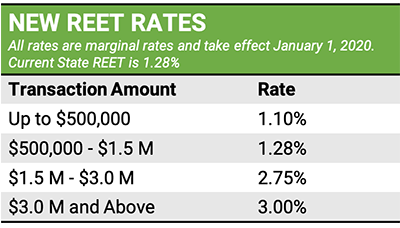
From the first days of the Legislative Session, we knew that the Legislature was committed to a Tiered Real Estate Excise Tax, based on the idea that higher priced properties would pay more in REET. Although we did not support this proposal, the Legislature listened to us when we spoke and made significant changes, with the result that approximately 90% of transactions will pay the same or less Real Estate Excise Tax. All Transactions up to $500,000 will get approximately a 15% cut in REET. In fact, due to the marginal nature of the new tiered tax (a REALTOR® suggestion), all transactions up to about $1.75M should not be impacted. While this tax impacts commercial real estate and multifamily, it is hoped that the marginal nature of the tax structure will limit that impact. These new rates will not take effect until January 1, 2020.

Protecting the Transaction

Very early in the session, a bill was introduced in both the House and Senate to require all parties in an “in-house” transaction to have an attorney sign off at every step in the transaction. Obviously, this bill would make real estate more expensive for consumers and greatly impede transactions. Washington REALTORS® jumped in and made sure this proposal did not even make it out of Committee in either the House or the Senate.

Increasing Transactions

Thanks to great work from our Washington REALTORS® Condominium Work Group and some passionate members across the state, Washington REALTORS® was able to help pass condominium liability reform that continues to protect the consumer but adds a fairer standard that should encourage developers to start building condominiums again. After looking at the more balanced bill, one developer told us that once developers got comfortable with the new regulations, we should expect a “mini condo boom” in Washington. Additionally, while working with a number of stakeholders, we passed a bill that encourages cities to adopt growth policies that allow for additional density in a responsible way, including Accessory Dwelling Units, allowing duplexes and triplexes in single family zoning and cluster zoning or lot size averaging allowances.

Homeowners Putting the Brakes on Remodeling

As the housing market slows, homeowners are halting their plans to upgrade their home. The booming housing market had been making homeowners feel like investing their growing equity into sprucing up their homes. Remodeling activity climbed to a decade high of 7.7 percent this year, according to a new report from Harvard University’s Joint Center of Housing Studies. But it predicts a slowdown over the coming months as the overall housing market eases.

“Low for-sale inventories are presenting a headwind because home sales tend to spur investments in remodeling and repair both before a sale and in the years following,” says Chris Herbert, the Joint Center’s director. Herbert also points to rising interest rates that are making buying a home more challenging for many Americans. This increase in rates also has an impact on the cost of tapping into home equity lines when funding big remodeling projects.

Credit Suisse downgraded shares of home remodeler retailers’ stocks due to the slower growth in home prices and projections of a slowing remodeling business. “Home prices have been a key driver of big-ticket projects, supporting strong average ticket growth,” Credit Suisse analysts write.

Source: REALTOR® Magazine

Fewer Americans Are Willing to Move for a Job

Fewer Americans are willing to uproot their lives to move for new job opportunities, suggests new census data.

About 3.5 million Americans relocated for a new job last year, a 10 percent drop from 3.8 million in 2015. The number has been trending lower, despite the overall population increasing 20 percent over that time, The Wall Street Journal reports.

Why are more people staying put? Experts told WSJ that some blame may rest on rebounding real estate values. Housing costs have soared higher in some regions where jobs may be more plentiful, like East and West Coast cities, but it may be pricing out some who may have otherwise been willing to relocate.

Read the full article on REALTORmagazine

Top 10 Threats to Real Estate in 2019

Rising interest rates and the economy are the top two current issues to watch in real estate, according to the Counselors of Real Estate’s Top Ten Issues Affecting Real Estate 2018-2019, a list of the biggest threats to the housing market. For the first time, CRE broke its annual list down into current and longer-term issues to watch during the industry’s next year.

Read the article on REALTORmagazine